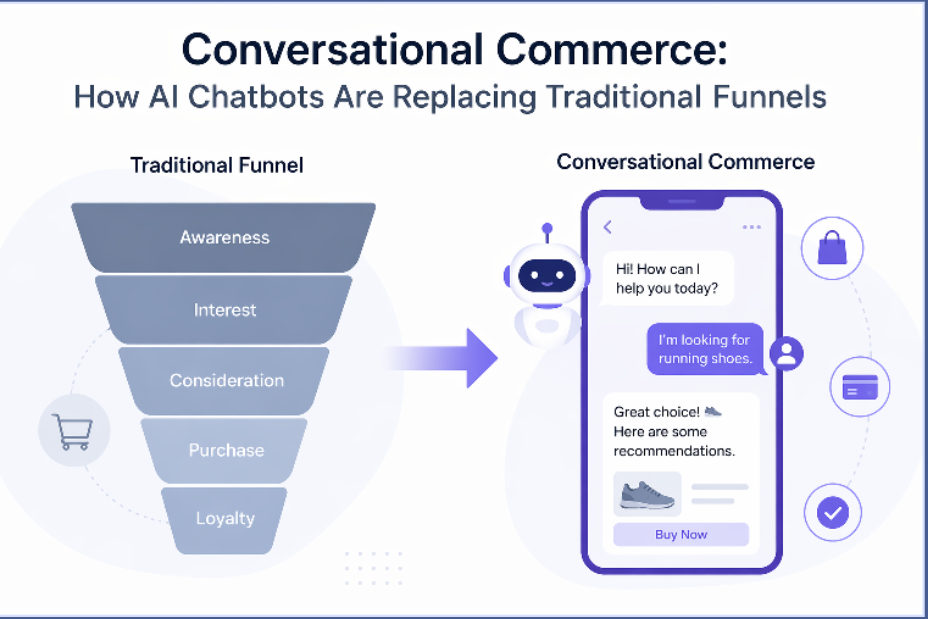
E-commerce today is fast and easy to access, but customers still make decisions on their own. Even with better design and quick checkout, many users feel confused or unsure. This is why drop-offs still happen. Conversational commerce changes this by adding AI chatbot guidance. Instead of clicking through pages, users can ask questions and get help instantly. Decisions happen through simple conversations, making the buying process clearer and easier to complete.
The Funnel Was Built for Navigation, Not Decision-Making
Traditional e-commerce funnels are built on the idea that users already know what they need. In reality, many customers are confused, comparing choices, or still deciding. This creates friction at every step. The system moves users forward but does little to support real decision-making.
This difference becomes clear when comparing Conversational commerce vs traditional e-commerce funnel models. The funnel works in steps and depends on pages, where users click, search, and decide on their own. An AI chatbot works differently. It understands what users mean in real time and guides them. Instead of moving step by step, the journey becomes simple, fast, and supported by conversation.
As a result, conversion loss is often not a traffic problem but a decision problem. When users lack clarity, they exit. When they receive guidance from an AI Chatbot for E-commerce, they proceed. This distinction reframes how performance should be measured.
AI Chatbots Are Restructuring the Sales Journey
- The AI chatbot in the sales funnel replaces fixed stages with adaptive conversations that respond to user behaviour.
- An AI-powered shopping assistant allows users to describe intent naturally instead of navigating rigid product categories.
- Systems interpret context and preferences to present relevant options, reducing manual filtering and decision fatigue.
- Sales interactions shift from page-based journeys to dynamic exchanges driven by real-time user inputs and signals.
- Performance depends on contextual understanding, making interaction quality more critical than interface design or layout.
Where Conversions Are Won or Lost in Real Time
Discovery Becomes Guided Instead of Self-Directed
Many users drop off early because they cannot decide what they want. An AI chatbot for product discovery and purchase reduces this problem by asking questions, understanding intent, and showing suitable products, making it easier for users to move forward.
Decision Friction Is Addressed Immediately
Hesitation often appears when users compare products, evaluate pricing, or question suitability. Real-time responses within the conversation resolve doubts instantly, preventing delays and reducing the likelihood of drop-offs caused by uncertainty or lack of timely guidance.
Checkout Is No Longer a Separate Phase
Old ecommerce flows divide product search and checkout, making the process longer. Conversational systems combine both in one chat, so users can select and pay without leaving the conversation, keeping the experience simple and reducing drop-offs at the final stage.
Abandonment Is Intercepted Before It Happens
Behavioral signals, such as inactivity, repeated comparisons, or exit intent, reveal hesitation before users leave. This is where e-commerce funnel drop-off reduction becomes measurable, as timely intervention addresses concerns while intent is still active and recoverable.
Post-Purchase Interaction Drives Additional Value
The purchase is not the end of the interaction anymore. AI chatbot follow-up conversations can suggest related products, answer questions, and support users after buying, helping businesses build stronger relationships and create more sales opportunities beyond the first transaction.
Why Implementation Determines Outcomes
Not all conversational systems deliver the same results. The difference lies in how well they are integrated into operational and data environments. Without access to customer data, behavioral signals, and transaction history, conversations remain generic. This limits their ability to influence decisions meaningfully.
Real-time conversational sales automation allows AI chatbot conversations to start based on user intent instead of fixed triggers. When the system responds at the right moment with relevant information, it improves user decisions and leads to higher conversions than delayed responses.
This is also where many deployments fall short. Standalone chat tools often operate without connection to CRM, analytics, or inventory systems. As a result, they respond, but they do not guide. The distinction between interaction and assistance becomes critical.
Platforms such as GetMyAI demonstrate how integration changes outcomes by connecting conversational interfaces with internal workflows and knowledge sources. This enables responses that are not only immediate but also contextually accurate and operationally relevant.
How to Evaluate the Shift from Funnels to Conversations
This shift is not about adding chat. It is about changing how decisions are supported. Instead of measuring page flow efficiency, teams need to assess how well the system helps users move from uncertainty to clarity in real time. To increase conversions with conversational commerce, evaluation must focus on decision support, not just interaction volume.
Evaluation Checklist:
- Does the system actively guide decisions instead of relying on users to navigate independently?
- Are conversations triggered by real-time behavioral signals such as hesitation or drop-off intent?
- Is user context used to personalize responses and narrow choices effectively?
- Can users complete discovery, evaluation, and purchase within a single conversation flow?
- Are metrics focused on conversion impact, time to decision, and assisted revenue instead of clicks?
Conclusion
E-commerce is moving beyond navigation-driven experiences toward interaction-driven decision-making. The limitations of traditional funnels are becoming more visible as customer expectations shift toward immediacy and relevance. A conversational AI for the shopping experience addresses this gap by introducing real-time guidance where there was previously none. The value is not just in automation, but in guiding user decisions at the right moment. Businesses that focus on this can design AI chatbot experiences that help users take action, leading to higher conversions instead of only attracting visitors.