Electric vehicles attract plenty of coverage for their range figures, charging speeds and price tags. Far less is said about the hardware tucked inside the battery pack, where an enormous amount of current has to move safely every time the car accelerates or plugs in.
Inside the Battery Pack
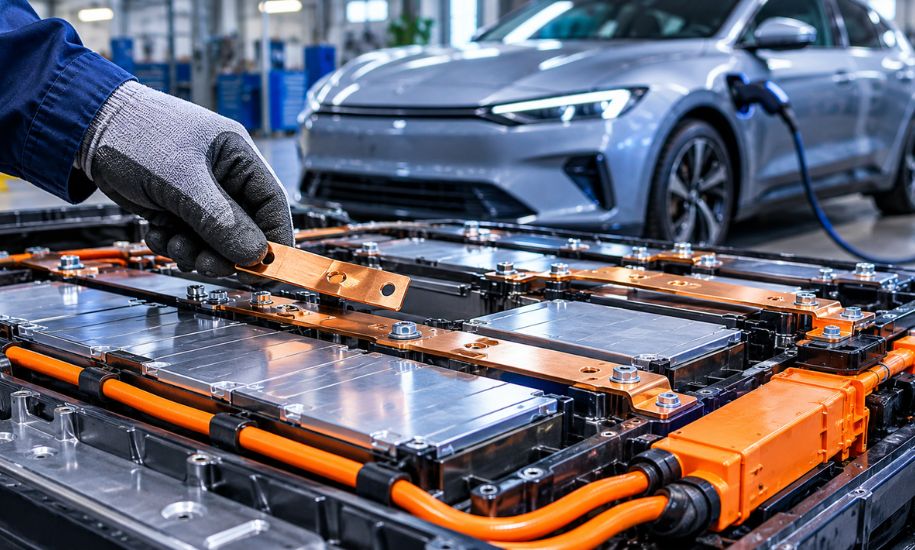
A typical electric car battery is made up of many individual cells grouped into modules. Those cells have to be connected so that their combined output reaches the motor, and the connections need to handle very high current without overheating. Engineers often rely on solid metal conductors known as busbars for the job, because they’re compact, rigid and easy to fit into a tightly packed enclosure.
Cables can do similar work, but they’re bulkier and harder to route through small gaps. A flat bar can be laid neatly across the top of a module, bolted or welded at each end and designed so that its resistance is predictable. In a vehicle where space and weight are constantly traded against each other, that tidiness counts for a lot.
Why Weight and Heat Both Matter
Weight is a constant concern in vehicle design, since every extra kilogram eats into range. That’s one reason aluminium has become common in this role. It doesn’t conduct as well as copper, but it weighs roughly a third as much. Copper still appears where space is limited and electrical performance takes priority.
Heat is the other worry. Resistance turns electrical energy into heat, and a poor connection can quickly become a hot spot. In a battery pack, a hot spot is more than an efficiency problem. It can speed up wear on nearby components and, in the worst cases, create safety risks. Thermal management systems exist to cope with this, but they work best when the connections themselves behave well.
The Problem With Bare Metal
Left untreated, both metals struggle. Copper darkens as it oxidises, and aluminium builds up a hard, insulating oxide film within moments of being exposed to air. At a bolted joint, those films raise contact resistance. A vehicle’s working life adds vibration, temperature swings and sometimes road salt or humidity, all of which make the situation worse.
A common remedy is electroplating, where a thin coating of tin, nickel or silver is deposited on the surface. The coating protects the base metal and gives the joint a more stable contact surface. Each option has its place. Tin is economical and corrosion resistant, nickel is tough, and silver offers excellent conductivity where performance matters most.
Quality Control Behind the Scenes
Coating a part is only half the task. Thickness, adhesion and consistency all affect how the finished component behaves. A layer that’s too thin may wear through, while one that’s too thick can crack or add cost without any benefit. Manufacturers typically verify thickness with X-ray fluorescence and carry out adhesion checks before parts are released.
Documentation matters too. Automotive and electrical customers generally expect traceability and accreditation to quality standards such as ISO 9001. That’s partly about confidence, and partly about being able to trace a problem back to its source if one ever appears months later.
Beyond the Car Park
The same principles apply well beyond passenger cars. Charging stations, grid-scale batteries and solar inverters all handle high current through compact connections. As charging speeds rise, so do the demands on those connections, because higher current brings more heat.
That helps explain why the industry is paying closer attention to details that once seemed minor. A joint that performs acceptably at modest currents may struggle once rapid charging becomes the norm, and the weakest connection in a pack tends to set the limit for the whole system.
Repair, Reuse and a Second Life
Battery packs are increasingly designed with a second life in mind. Packs that no longer suit a car may still serve as stationary storage, and parts can be repaired or replaced rather than the whole unit being scrapped. That puts extra weight on connections that can be unbolted, inspected and reassembled without damage to the surface.
Corrosion can undermine that plan. If a joint has oxidised or the plating has worn through, disassembly may reveal damage that makes reuse uneconomic. A durable finish keeps the option open, and it can reduce waste as well as cost.
What the Industry Is Learning
Early electric vehicles were often cautious in their design, with generous margins on current and heat. Newer models push harder, with faster charging and more compact packs, so the margins are narrower and the connections are working closer to their limits.
Engineers have responded with better modelling, more thermal sensors and closer attention to materials. Testing now routinely includes vibration, humidity and thermal cycling, because real-world conditions rarely resemble a laboratory bench. Surface finish is part of that testing, since it influences how a joint ages.
Small Components, Big Consequences
It’s easy to assume the story of electric transport is all about cells, software and charging networks. Those matter enormously, but the unglamorous parts that join everything together deserve a place in the conversation. A well-finished conductor can sit unnoticed for the life of a vehicle.
When the parts do their job, nobody thinks about them. When they don’t, the consequences can be costly and sometimes dangerous, which is why careful design, sensible material choices and proper surface treatment remain central to the technology.
You may also visit: Technology.