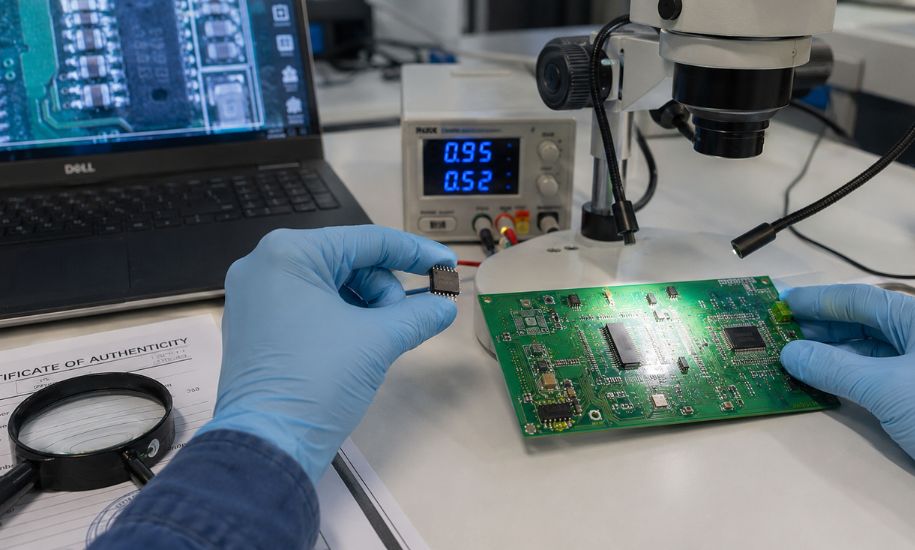
A recent survey of production for a recent design by an electronics manufacturer found that 40% of the production run failed the factory acceptance test. Upon closer inspection it was found that the cause of failure was due to the use of counterfeit capacitors purchased from a seemingly legitimate on-line supplier. The components looked correct with all the expected markings and packaging. However, closer inspection under a microscope revealed the inferior materials used in the counterfeit components.
Online purchased components for all industries contain an ever increasing risk of being counterfeit after verification and checking as thoroughly as possible. There is a 100 % test to check for authenticity: purchase from the manufacturer directly or from an authorized distributor. After that there is no 100 % guarantee any more that the purchased components are not counterfeit.
The Scale of the Counterfeit Problem
Fear of counterfeit components has become a reality for many companies as the problem continues to grow. Recently the problem was reported to be a $169 billion a year problem and although many people assume that low cost components are obviously going to be counterfeit this is not the case, in fact the vast majority of suspect components look to be 100% genuine and deceive even the most experienced engineers at first glance.
There has been a significant upsurge in the sophistication of the production of these counterfeit components. Today many of the distributors and resellers of electronic components are purchasing online from suppliers such as Fusion electronic components shop. These counterfeit components are packaged, documented and even marked with component markings indistinguishable from those produced by the original component manufacturers.
What looks like legitimate parts to the surface could have some serious flaws in the internal parts. Many of the components produced by counterfeiters use low quality materials in an attempt to save time and or money. Sometimes they might even skip out a few of the normal steps of the manufacturing process. The internal structure of a legitimate part and a counterfeit part could be entirely different. For example a counterfeit microprocessor may act perfectly normal for a while at light loads but fail catastrophically at full loads.
Documentation Tells the Story
Authentic component suppliers provide full documentation for all of the components that they sell. That is how you can avoid buying counterfeit components. The certificates of authenticity that are provided by a supplier that is able to provide documentation for the components that you are purchasing will contain information that traces the components that you purchased back to the original manufacturer of that part. The batch numbers, the manufacturing date
The Certificate of Authenticity is typically supplied by the official supplier of a component. The Certificate of Authenticity provides proof that a component is an official, authentic part. The supplier of a genuine part will be able to supply a Certificate of Authenticity that confirms that the part is an official, authentic component. The Certificate of Authenticity will include information such as the batch number of the component, the date that the component was manufactured and the results of a variety of relevant tests that were carried out on the component.
Older parts typically decline in efficiency over time. Even high quality components may function less efficiently as they grow old. It is, therefore, also important to verify the manufacturing date for any part. Storing proper inventory in suitable conditions is an important part of being a parts supplier such as the Fusion electronic components shop. Older components simply do not function as efficiently as their brand new counterparts.
Physical Inspection Techniques
Verification of authenticity can be completed by first visually inspecting the parts for obvious signs of counterfeiting and then verifying the markings and labeling. The components must appear to have been properly manufactured and meet the specifications for the component.
Component markings – Component markings should be clear and consistant. Laser etching is typical for high quality components and usually results in very clear and uniform markings. Fuzzy or uneven markings with different font weights are typical for counterfeit components.
When looking at components look for sealed bags or boxes with labeling. Also verify the physical dimensions of a part with a digital caliper. Some of the fake parts are made to be slightly off so they appear to be okay by the naked eye.
Testing Beyond Appearances
The most convincing fakes can only be detected by means of electrical testing, i.e. during the very first functionality test.
The biggest weakness of all counterfeits (by far) is the inferior quality of the materials used to make them. These components can be uncovered very quickly by performing temperature cycling. Since components are designed to function within a specified temperature range, verifying a component’s performance over this range of life will quickly reveal any inferior components. Once a component has been placed into service, exposing it to extreme temperatures will allow it to degrade over time.
Voltage stress testing should also be conducted by testing the components at the maximum rated voltage for an extended amount of time to look for any degradation.
When Professional Help Makes Sense
In some cases the verification of authenticity of certain parts may be required which will be outside the scope of normal purchasing activities. This can involve the use of X-ray, decapsulation of parts and materials analysis. This type of verification will provide absolute proof of a part’s origin.
Verification testing on products is often carried out by specialist testing companies. Such companies have a wealth of knowledge on a wide variety of products, are generally very experienced at what they do, and in many cases have strong links with component manufacturers. Furthermore, they have access to the very latest reference samples for verification purposes. This makes such companies ideal candidates for verification testing of components and other products.
Building Reliable Supply Relationships
The purchasing department of a company should make the verification of suppliers with respect to their ability to verify components as being original a high priority. A good starting point for verification are the Authorized Distributors of a component manufacturer. They are bought directly by the manufacturers, hence the supply chain is “clean” (no intermediaries with the intention to sell fake components).
Authorized distributors are typically the most reliable suppliers of parts as they purchase from the manufacturers and therefore the components have passed through fewer hands than that of an Independent Distributor. The Independent Distributor is not to be written off though, especially in cases where the purchaser requires obsolete components or needs them delivered very quickly. In these situations it is important to choose a supplier that has its own
When authorized distributors are not able to supply required parts (for example, old stock parts or parts required quickly), other suppliers verify the components to be sold by them. The important point to consider when purchasing from independent suppliers is the verification processes that they complete for the components that they are selling.
Ask your supplier for a description of the steps he takes in order to guarantee the authenticity of the components he is selling to you. Show him some respect by asking to see some of the documentation he has in order to verify the components and find out what information he has gathered in order to guarantee the authenticity of the components he is selling. This will give you an idea whether the supplier you are talking to knows what to do in order to guarantee the authenticity of the components he is selling.
Even the best process today can fall victim to tomorrow’s newest and most sophisticated counterfeit parts. So the time and money spent on verification today is a very small price to pay for the assurance that you are keeping suspect components out of your production process.
You may also visit: Technology.