Healthcare products often solve serious problems, but explaining them is not always easy. A medical device may support a procedure, improve diagnostic accuracy, assist recovery, or help clinicians work more efficiently. The challenge is that much of its value may be hidden inside the product or connected to a process the audience cannot easily see.
That is where animation becomes useful.
Animated medical product videos help healthcare brands show how a product works, why it matters, and how it fits into real clinical use. Instead of relying only on technical sheets, product photos, or long sales explanations, animation turns the product story into a clear visual experience.
For medical device companies, healthcare startups, and clinical product teams, this can make communication faster, more accurate, and easier to trust.
Medical Products Need Clear Visual Explanation
Medical products often involve detailed mechanisms. They may interact with anatomy, support internal movement, measure biological data, or assist a treatment process. A simple image rarely explains enough.
Animation helps fill that gap.
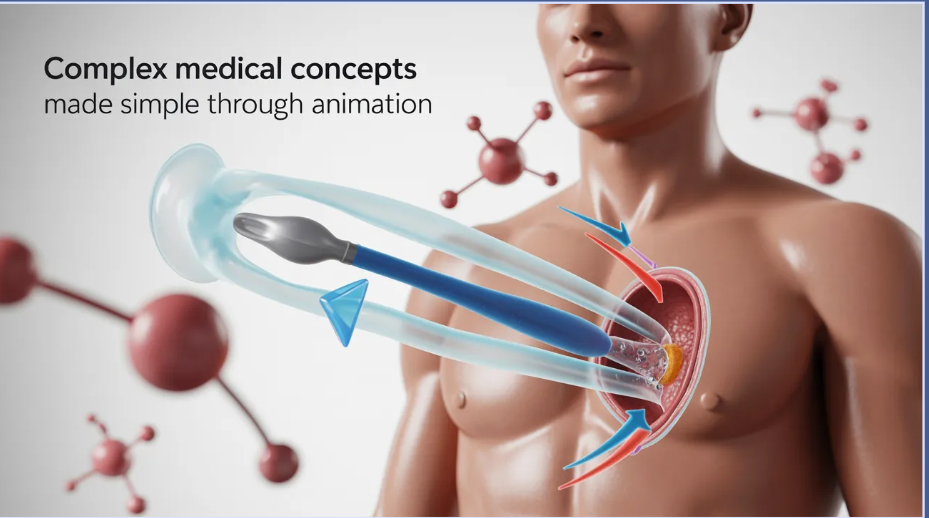
A video can show the product from the outside, then reveal what happens internally. It can show how the device is placed, how it moves, how it supports a procedure, or how it affects a specific part of the body.
This makes the product easier to understand for doctors, buyers, investors, patients, and sales teams.
Clarity matters because healthcare audiences are careful. They want information that is useful, accurate, and easy to follow.
Animation Helps Different Audiences Understand the Same Product
One medical product may need to be explained to several groups.
Clinicians may want technical accuracy. Patients may need reassurance. Hospital buyers may care about workflow and practical value. Investors may want to understand market use and product potential.
Animation helps create a shared visual foundation.
Instead of preparing completely different explanations for every audience, brands can use one strong animated video and adjust the level of detail for each use case.
A short patient-facing version may focus on comfort and procedure steps. A clinician-facing version may show anatomy, device positioning, and function. A business-facing version may focus on use case, efficiency, and product differentiation.
3D Animation Can Show What Cameras Cannot
Many healthcare products are difficult to film properly. Some are too small, some work inside the body, and some involve movement that cannot be captured clearly in a live-action setup.
3D animation gives full control over the visual explanation.
A product can be shown from any angle. Internal features can be highlighted. Anatomy can be simplified for clarity. The product can be placed inside a realistic medical setting without needing a live procedure.
A 3D medical animation company can help healthcare brands create these detailed visuals while keeping the message medically careful and easy to understand.
This is especially helpful for surgical tools, implants, diagnostic devices, pharmaceutical delivery systems, and treatment technologies.
Product Videos Build Confidence Before Conversations
Healthcare sales and education often involve long explanations. A representative may spend several minutes explaining a product before the audience fully understands it.
A strong product video can shorten that process.
When viewers see how the product works first, the conversation becomes more focused. Clinicians can ask better questions. Buyers can understand the use case faster. Patients can feel less confused about what to expect.
This does not replace expert guidance. It supports it.
Good animation gives people a clearer starting point before deeper discussion begins.
Medical Product Animation Supports Launches
Product launches in healthcare need careful communication. The product must be introduced clearly, but the message cannot feel exaggerated or vague.
Animation helps structure the launch story.
A product launch video can open with the medical problem, introduce the product, show how it works, and explain the practical benefit. This keeps the story focused and avoids overloading the viewer with too many technical details at once.
A 3D product video animation company can also help create launch visuals before the final product is widely available, using design files, prototypes, models, or engineering references.
This is useful for conferences, investor presentations, product pages, and pre-launch campaigns.
Strong Animation Reduces Misunderstanding
In healthcare, unclear communication can create problems. If a product is misunderstood, the audience may overlook its value or ask the wrong questions.
Animation helps reduce that risk by showing the product step by step.
For example, a video can show where the device is used, what it does, and what changes during the process. It can slow down important movements and highlight the parts that matter most.
This gives the viewer a cleaner understanding without forcing them to interpret technical language on their own.
The best medical product animations are simple, but not shallow. They remove confusion while keeping the information accurate.
Sales Teams Can Use Animation Across the Buying Journey
A medical product video can support several stages of sales and marketing.
It can be used in:
- Product launch presentations
- Trade show booths
- Sales meetings
- Hospital buyer discussions
- Investor decks
- Website product pages
- Email follow-ups
- Training sessions
This makes animation more than a single marketing asset. It becomes a practical communication tool that supports the full buying journey.
For sales teams, that consistency is valuable. Everyone can explain the product with the same visual story.
The Best Medical Product Videos Stay Focused
A common mistake is trying to include every product feature in one video. Medical products often have many technical details, but not all of them belong in the first explanation.
A strong video focuses on one main goal.
That goal might be explaining the product mechanism, showing clinical use, supporting a launch, educating patients, or helping sales teams communicate value.
Once the goal is clear, the script and visuals become easier to shape. Every scene should help the viewer understand the product better.
If a detail does not support the main message, it may be better saved for a technical document, training module, or follow-up presentation.
Animation Works Best When It Feels Accurate and Calm
Medical animation should not feel flashy for the sake of attention. Healthcare audiences respond better to visuals that feel clear, calm, and credible.
The tone should match the subject.
That means clean pacing, careful labeling, accurate product movement, and responsible visual choices. The animation should make the product easier to understand without making claims that go beyond what the product can do.
In medical communication, trust is built through clarity and restraint.
Frequently Asked Questions
What Is Medical Product Animation?
Medical product animation is a visual video format that explains how a healthcare product, device, or technology works through animated visuals.
Why Do Healthcare Brands Use Product Animation?
Healthcare brands use product animation to explain complex devices, show internal details, support launches, and help audiences understand product value faster.
Can Animation Help Explain Medical Devices to Patients?
Yes. Animation can show how a device is used and what patients can expect, making the information easier to understand.
Where Can Medical Product Videos Be Used?
They can be used on websites, product pages, sales decks, trade shows, investor presentations, training programs, and patient education materials.
How Long Should a Medical Product Animation Be?
Most medical product animations work best between 60 and 120 seconds, depending on the product, audience, and level of detail needed.
Final Words
Animated medical product videos help healthcare brands explain complex products with more confidence. They can show hidden details, simplify clinical use, support product launches, and make sales conversations easier.
When a product is difficult to explain through photos or technical copy alone, animation gives audiences a clearer way to understand how it works and why it matters.