The Tretinoin Learning Curve: Why Smarter Use Matters More Than Maximum Strength

Few skincare ingredients have a history as long, an evidence base as substantial or a reputation as formidable as tretinoin. It has been prescribed for acne for decades, studied for the visible effects of sun damage and incorporated into combination treatments for selected pigmentation disorders.
It is also one of the most frequently misunderstood products in modern skincare.
Some consumers assume that the highest percentage will produce the fastest transformation. Others stop after the first episode of dryness, believing their skin is “allergic” to retinoids. Social-media routines often place tretinoin beside acids, scrubs and multiple acne treatments, turning an evidence-based medicine into an uncontrolled irritation experiment.
Tretinoin works best when approached differently. The objective is not to provoke maximum peeling. It is to find a formulation, strength and application schedule that the skin can tolerate consistently under appropriate medical guidance.
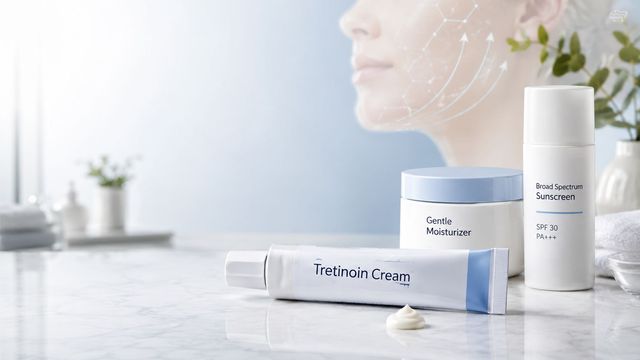
Suggested image: A professional landscape photograph showing an unbranded tretinoin-style cream tube, a small measured amount of cream, a gentle moisturizer and sunscreen arranged against a clean dermatology-inspired background. Caption: “Successful tretinoin treatment depends on consistency, tolerability and sun protection—not visible peeling.”
Tretinoin Is a Retinoid, but It Is Not Retinol
Tretinoin is all-trans retinoic acid, a prescription retinoid related to vitamin A. Retinol is also part of the retinoid family, but it is commonly used in non-prescription cosmetic products and is generally less potent.
That distinction matters. A cosmetic retinol product and a prescription tretinoin medicine may appear similar on a bathroom shelf, but they should not be expected to produce identical effects, irritation or treatment timelines.
Official prescribing information describes topical tretinoin as a treatment for acne vulgaris. It reduces the cohesion of cells within the follicle, helps limit the formation of microcomedones—the microscopic precursors of clogged pores—and increases turnover within the follicular epithelium. These actions help existing comedones clear while reducing the conditions that allow new ones to develop.
The American Academy of Dermatology includes tretinoin among the prescription topical retinoids used to treat acne. Retinoids can help clear blackheads, whiteheads and some inflammatory lesions, and may also be used as maintenance treatment after acne has improved.
Why Tretinoin Is More Than an Acne Treatment
Tretinoin’s reputation in anti-ageing skincare did not originate solely from marketing. Controlled clinical research has documented improvements in several visible features associated with photodamage.
An early randomized, double-blind study found that tretinoin-treated skin improved significantly compared with vehicle-treated skin over 16 weeks. Researchers observed both visible and histological changes, while irritation was the principal adverse effect.
Longer and larger studies subsequently reported improvements in fine wrinkling, mottled pigmentation, roughness and other signs of sun-damaged skin. In one multicentre trial involving 251 participants, 79% of those treated with 0.05% tretinoin showed overall improvement after 24 weeks, compared with 48% of vehicle-treated participants.
A systematic review of randomized trials published in 2022 concluded that topical tretinoin consistently improved several clinical signs of photoageing, including fine wrinkling, uneven pigmentation and sallowness. A newer meta-analysis covering eight trials and 1,361 participants likewise found significant improvements in both fine and coarse facial wrinkles caused by photodamage.
These findings do not mean that tretinoin reverses every feature of ageing. It cannot replace lost facial volume, tighten markedly lax tissue or erase deep structural scars. Its strongest evidence relates to acne, surface texture, fine photodamage, mottled pigmentation and selected signs of chronic sun exposure.
Stronger Is Not Automatically Better
Tretinoin is commonly available in concentrations such as 0.025%, 0.05% and 0.1%. The numbers naturally encourage consumers to think of them as beginner, intermediate and advanced levels.
Clinical evidence suggests that the relationship between concentration and results is more complicated.
In a 48-week randomized study, both 0.025% and 0.1% tretinoin produced significant clinical and microscopic improvement in photoaged skin. The two concentrations produced broadly similar efficacy, but the 0.1% treatment caused significantly more redness and scaling.
This does not prove that the concentrations are interchangeable for every patient or every condition. Acne severity, formulation, skin type, treatment history and adherence can all influence the choice. It does demonstrate an important principle: increasing irritation does not necessarily increase improvement.
A lower strength used consistently may be more productive than a stronger preparation that repeatedly forces the user to stop. Tolerability is not a secondary concern. It is part of treatment effectiveness.
Cream, Gel, Lotion and Microsphere Formulas Are Not Identical
Concentration is only one variable. The delivery vehicle can influence application, skin feel, stability and tolerability.
Traditional tretinoin is available in cream and gel bases. Microsphere gels use porous polymer particles to carry tretinoin within an aqueous formulation. Current U.S. prescribing information lists microsphere concentrations of 0.04%, 0.08% and 0.1%, depending on the particular product.
Microsphere technology does not make irritation impossible. In a 12-week study comparing two microsphere strengths, local adverse events were reported more frequently in the 0.1% group than in the 0.04% group. Again, the result reinforces the importance of concentration and individual tolerance rather than supporting a simple “stronger is better” rule.
At the time of review, the OKDERMO tretinoin collection displayed 30 listings, including standard creams and gels, microsphere preparations, topical lotion and combination products containing ingredients such as hydroquinone, azelaic acid or clindamycin. Available concentrations included 0.02%, 0.025%, 0.04%, 0.05% and 0.1%, depending on the product and formulation.
These products should not be treated as automatic substitutes for one another. Changing from a cream to an alcohol-based gel, from plain tretinoin to a combination medicine, or from a conventional formula to a microsphere system can change both the treatment experience and the relevant precautions.
What Responsible Application Looks Like
Product-specific directions and the prescriber’s instructions should always take priority. For conventional tretinoin cream, official labeling generally directs users to apply a light covering to the entire acne-affected area once daily, usually in the evening. Applying the medicine only to visible pimples misses the microscopic blockages developing elsewhere in the treatment area.
Using additional product does not accelerate the process. Excessive application can instead cause marked redness, peeling and discomfort. Current microsphere labeling similarly warns that using more than needed or applying it more than once daily will not produce faster or better results.
A practical routine usually remains deliberately simple:
- Cleanse gently without scrubbing.
- Allow the skin to dry as directed.
- Apply a thin, even layer to the prescribed area.
- Avoid the eyes, lips, corners of the nose and other mucosal surfaces.
- Use a moisturizer when needed to support the skin barrier.
- Apply broad-spectrum sun protection during the day.
The American Academy of Dermatology notes that clinicians may reduce irritation by recommending a smaller quantity, less frequent use or moisturizer before the retinoid. These adjustments should be made within the treatment plan rather than by repeatedly starting and stopping without guidance.
The Adjustment Period Is Not a Competition
Dryness, tightness, mild burning, redness and flaking are well-recognized local effects of topical tretinoin. Some patients also experience an early increase in inflammatory lesions as previously developing blockages become visible. Official labeling states that initial worsening can occur and that definite improvement may require more than six or seven weeks.
This period is often called “retinization.” It should not be interpreted as evidence that severe inflammation is necessary for treatment to work.
Persistent swelling, blistering, crusting, intense pain or severe dermatitis requires more than patience. The product should be stopped or reviewed according to medical advice. Strong irritation can also leave vulnerable skin more prone to temporary pigment changes, particularly when inflammation is prolonged.
A damaged barrier is not proof of accelerated collagen production. Visible peeling is an adverse effect, not a measure of biological success.
Sun Protection Is Part of the Treatment
Tretinoin-treated skin can become more vulnerable to sunlight and sunburn. Official labeling advises minimizing exposure to sunlight and artificial ultraviolet sources, avoiding application to sunburned skin and using sunscreen and protective clothing when exposure cannot be avoided.
This is particularly important when tretinoin is being used to improve uneven pigmentation or signs of photodamage. New ultraviolet exposure can stimulate pigmentation and degrade collagen while the patient is trying to address those same concerns.
Sun protection should therefore be treated as part of the regimen rather than an optional accessory. Customers building a complete routine can compare daily sun-protection products separately from their nighttime treatment and select a broad-spectrum formula appropriate for their skin type and local climate.
No tretinoin percentage can compensate for repeated unprotected ultraviolet exposure.
Combination Creams Require Their Own Treatment Plan
A product containing tretinoin plus another active ingredient is not simply “tretinoin with an extra benefit.” It is a different medicine with additional indications, limitations and risks.
Tri-Luma, for example, combines tretinoin 0.05%, hydroquinone 4% and the corticosteroid fluocinolone acetonide 0.01%. Its official indication is the short-term treatment of moderate-to-severe facial melasma together with sun avoidance and sunscreen. It is not indicated as continuous maintenance therapy.
That distinction is important because combination formulas may contain corticosteroids, antibiotics or pigment-inhibiting agents that are unsuitable for unrestricted long-term use. A cream designed for melasma should not automatically be repurposed as a general brightening moisturizer. Likewise, an antibiotic-tretinoin gel should not be used indefinitely without considering antimicrobial stewardship and the original treatment plan.
The front label may emphasize tretinoin, but the complete ingredient list determines the product’s risk profile.
Pregnancy Requires Special Caution
Oral retinoids are known to cause severe fetal harm. Systemic absorption from correctly applied topical tretinoin is much lower, and observational human studies have not established an increased rate of major birth defects or miscarriage from topical exposure. Nevertheless, the available studies have limitations, and animal studies have identified developmental effects at higher exposures.
Older and current labels therefore advise patients who are pregnant, planning pregnancy or breastfeeding to consult a healthcare professional before using topical tretinoin. Many clinicians recommend avoiding topical retinoids during pregnancy as a precaution.
This is not an area for self-experimentation or reassurance based solely on low topical absorption.
Topical and Oral Tretinoin Must Never Be Confused
Tretinoin also exists as a 10 mg oral capsule, but oral tretinoin is not an acne or anti-ageing product. It is a specialist oncology medicine used in the treatment of acute promyelocytic leukaemia.
Its prescribing information carries boxed warnings for embryo-fetal toxicity and differentiation syndrome, a potentially fatal complication requiring immediate specialist treatment.
The presence of the same active name on a capsule and a skincare tube does not make the products interchangeable. Oral tretinoin belongs under the direction of an oncology team and should never be used for cosmetic purposes.
How to Compare Tretinoin Products Intelligently
A responsible buyer should look beyond price, reviews and percentage. Before selecting or ordering a product, verify:
- The exact active ingredient. Tretinoin is different from retinol, retinaldehyde, adapalene, tazarotene and isotretinoin.
- The concentration. Confirm whether the product contains 0.025%, 0.05%, 0.1% or another strength.
- The formulation. Cream, gel, microsphere gel, lotion and combination cream can behave differently.
- Every additional active ingredient. Hydroquinone, corticosteroids, antibiotics and azelaic acid introduce separate indications and precautions.
- The manufacturer and packaging. Check batch information, expiry date, seal integrity and storage requirements.
- Prescription and import requirements. Tretinoin’s legal classification varies between countries, and the purchaser must comply with local rules.
- The treatment objective. Acne, photodamage and melasma are different clinical problems and may require different formulations or combination strategies.
Consistency Produces Better Results Than Aggression
Tretinoin has endured because it is supported by decades of pharmacological use and controlled research. Its effectiveness, however, does not eliminate the need for restraint.
The ideal routine is rarely the one with the greatest number of active ingredients or the highest tretinoin concentration. It is the routine that addresses a properly identified concern, protects the skin barrier, limits avoidable irritation and can be followed consistently.
That often means starting conservatively, applying less product than expected, moisturizing more than expected and waiting longer than social media suggests.
Tretinoin is powerful—but the most successful users do not try to overpower their skin. They give the medicine the conditions it needs to work.
Medical notice: This article provides general educational information and does not replace diagnosis, prescribing or individualized advice from a qualified healthcare professional. Tretinoin is a prescription medicine in many jurisdictions. Do not begin, combine, switch or increase tretinoin products without appropriate guidance. Seek medical advice for severe irritation, pregnancy-related questions, unusual pigment changes or worsening skin disease.