Dental Implants vs Dentures vs Dental Bridges in Singapore: Which Option Is Right for You?

Losing a tooth forces a decision most people never expected to make: how do you actually replace it? Walk into any dental clinic and you will likely hear three names come up again and again, dentures, bridges, and dental implants. Each works differently, costs differently, and suits a different kind of patient. If you have started comparing dental implants in Singapore against the other two options, you are already asking the right question, because the “best” choice really depends on your bone health, budget, and how much you value a permanent fix versus a faster, cheaper one.
This is not a decision to rush based on price alone. The option you pick affects how your jaw ages over the next decade, how confident you feel biting into an apple in public, and whether you will be back in the dentist’s chair again in five years for a replacement. Below is a straightforward comparison of all three options, plus an honest look at how tooth loss and its replacement can quietly affect your mental wellness too.
How Each Option Actually Works
Dental Implants
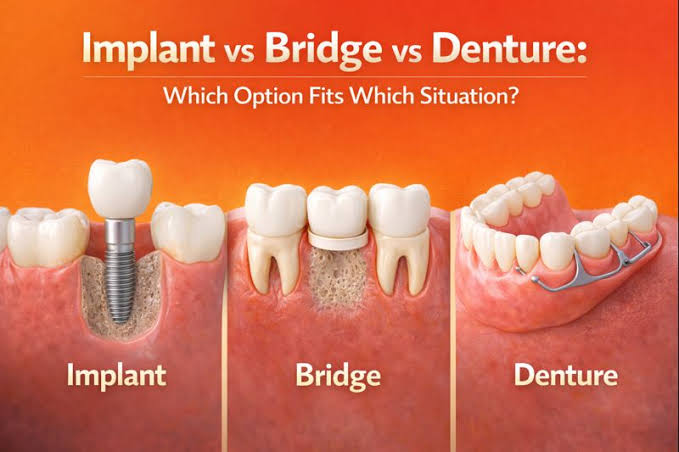
A titanium post is surgically placed directly into the jawbone, acting as an artificial tooth root. Once it fuses with the bone through a process called osseointegration, usually over three to six months, a custom crown is attached on top. Because the implant stands independently, it does not rely on neighbouring teeth for support.
Dental Bridges
A bridge spans the gap left by a missing tooth using the teeth on either side as anchors. Those adjacent teeth are filed down and fitted with crowns, which then support a false tooth (called a pontic) in between. It is a fixed solution, meaning you do not remove it, but it does require healthy teeth on both sides of the gap.
Dentures
Dentures are removable appliances that sit on the gums. Partial dentures clip onto your remaining natural teeth, while complete dentures are used when most or all teeth are missing. They are the least invasive of the three options but need to be taken out daily for cleaning.
Comparing Cost, Comfort, and Commitment
What You Pay Upfront
Pricing is often the first thing people compare, and the gap between options is real. Here is a general breakdown of what to expect in Singapore:
- Dentures typically range from around S$300 to S$3,500 per arch, depending on material and whether it is partial or complete
- Dental bridges usually cost between S$1,500 and S$3,500 for a three-unit bridge
- A single dental implant generally runs from S$2,500 to S$6,000, depending on the brand and whether bone grafting is needed
- Implant-supported dentures, a hybrid option for patients missing many teeth, can cost S$8,000 to S$25,000 depending on complexity
- MediSave can offset part of the surgical cost of an implant, though it does not typically cover the crown, abutment, or removable dentures
What You Pay Over Time
The sticker price only tells half the story. Dentures often need relining or replacing every five to ten years as your gums and jawbone shift shape. Bridges typically last ten to fifteen years before the supporting teeth or the bridge itself need attention. Implants, once successfully placed, can last decades with proper care, which is why many patients find the long-term cost evens out or even favours implants despite the higher starting price.
Which Option Preserves Your Jawbone
This is one of the most overlooked differences between the three. When a tooth root is missing, the jawbone beneath it begins to lose density over time because it no longer receives the stimulation a natural root provides. Bridges and dentures sit above the gum line and do nothing to address this root-level gap. Dental implants, by contrast, function much like a natural root, which helps maintain bone density at the site.
This matters more than it might seem at first glance. Over years, unaddressed bone loss can change the shape of your face, cause dentures to fit loosely, and make future implant placement more complicated if you delay too long. Patients planning long-term should weigh this factor heavily, not just the upfront cost.
The Emotional Side of Choosing a Replacement
Tooth loss is rarely just a clinical inconvenience. Research on oral health and mental wellness has repeatedly found links between missing teeth and lower self-esteem, along with higher rates of self-reported poor mental health. People often describe hiding their smile in photos, feeling anxious before job interviews or dates, or avoiding laughing openly in front of others. These reactions are common, not exaggerated, and they matter when weighing your options.
The replacement method you choose can shape how quickly that confidence returns. Some patients feel most at ease with a fixed solution they never have to think about, while others are comfortable with the daily routine of removing and cleaning dentures. A few emotional and lifestyle factors worth reflecting on before deciding include:
- How self-conscious you feel about visible gaps or removable appliances
- Whether you are comfortable with a multi-month healing process for an implant
- How much daily maintenance you are realistically willing to commit to
- Whether cost concerns are adding stress that a payment plan or MediSave could ease
- How the decision affects your confidence in work, social, or dating situations
There is no wrong answer here. What matters is being honest with yourself and your dentist about which trade-offs you can live with, rather than choosing based on price alone and regretting it later.
Which Option Fits Your Situation
Each option genuinely suits different circumstances, and a good dentist will walk you through this rather than pushing a single solution. Dentures tend to work well for patients replacing multiple teeth on a tighter budget, or those who prefer avoiding surgery altogether. Bridges make sense when the teeth next to the gap already need crowns for other reasons, since the procedure serves two purposes at once. Implants are typically recommended when the adjacent teeth are healthy and you want a solution that stands on its own without affecting them.
Clinics such as Nuffield Dental often begin with a detailed assessment, including X-rays and a discussion of your bone health, lifestyle, and budget, before recommending one option over another. That kind of structured, unhurried consultation is worth seeking out regardless of which clinic you choose, since a rushed recommendation rarely accounts for your specific mouth and circumstances.
Final Verdict on Choosing the Right Fit
There is no universal winner between dental implants, bridges, and dentures, only the option that best matches your bone health, budget, and how you want to live with your smile for the next ten or twenty years. Implants offer the most durable, bone-preserving solution but ask for a higher upfront investment and a longer healing timeline. Bridges provide a fixed, faster fix when neighbouring teeth already need attention. Dentures remain a practical, lower-cost route for many patients, particularly when multiple teeth need replacing. Whichever path fits your life, sit down with a dentist who takes time to explain the trade-offs clearly, because the right choice is the one you will feel confident about years from now, not just on the day you sign the treatment plan.