
Moving to a new country is a monumental task. Between finding a home, navigating the NHS, and adjusting to the British weather, the administrative “to-do” list can feel endless. However, there is one area where “getting it wrong” can lead to significant stress and financial penalties: the UK tax system.
For many newcomers, the realization that the UK tax system works differently from their home country comes as a shock. Whether it’s the shift in responsibility under Self-Assessment, the complexities of National Insurance, or the nuances of HMRC’s digital portals, the learning curve is steep. If you are earning money from abroad, running a side hustle, or simply earning a high salary, you are no longer just an employee; you are a taxpayer with specific reporting obligations.
While the system is logical once understood, navigating the crossover between foreign and UK income often requires the steady hand of a tax accountant for foreigners to ensure you aren’t paying more than your fair share or worse, missing a deadline that triggers an automatic fine. This guide is designed to dismantle the jargon and provide a clear, actionable roadmap for your financial life in the UK.
Do You Need to File a UK Tax Return?
The most common question immigrants ask is: “Does HMRC already have my information?” If you are used to a system where the government does the math for you, the UK’s “Self-Assessment” model can be confusing.
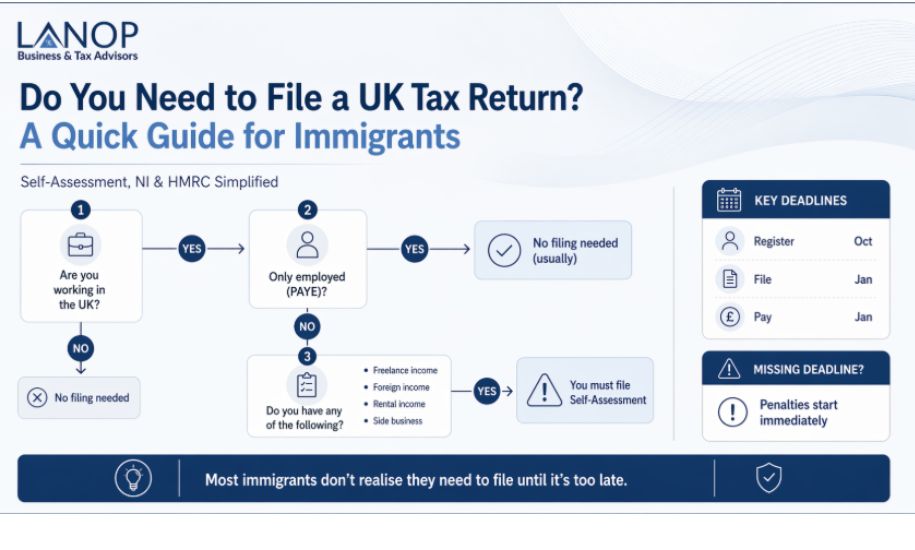
Who Must File Self-Assessment in the UK?
You generally need to file a tax return if any of the following applied in the last tax year (6 April to 5 April):
- Self-Employed/Freelance: You earned more than £1,000 from self-employment.
- Foreign Income: You received income from abroad (rent, dividends, or freelance work for overseas clients).
- Property Income: You earned more than £2,500 from renting out property (UK or overseas).
- High Earners: Your income was over £150,000 (even if paid via a UK employer).
- Complex Income: You received significant income from dividends or savings interest.
Who Usually Does NOT Need to File?
If your only income is your salary from a UK employer and it is below £150,000, you are likely under the PAYE (Pay As You Earn) system. In this case, your employer deducts tax and National Insurance before you receive your paycheck, and you usually don’t need to file a separate return.
Simple Decision Framework
- Is your only income a UK salary? $\rightarrow$ No (Usually).
- Do you have money coming in from outside the UK? $\rightarrow$ Yes.
- Are you registered as a sole trader or business owner? $\rightarrow$ Yes.
- Is your income “complex” (multiple sources/landlord)? $\rightarrow$ Yes.

UK Tax
Understanding the UK Tax System as an Immigrant
Before you can file, you need to understand the “who” and the “where” of UK finance.
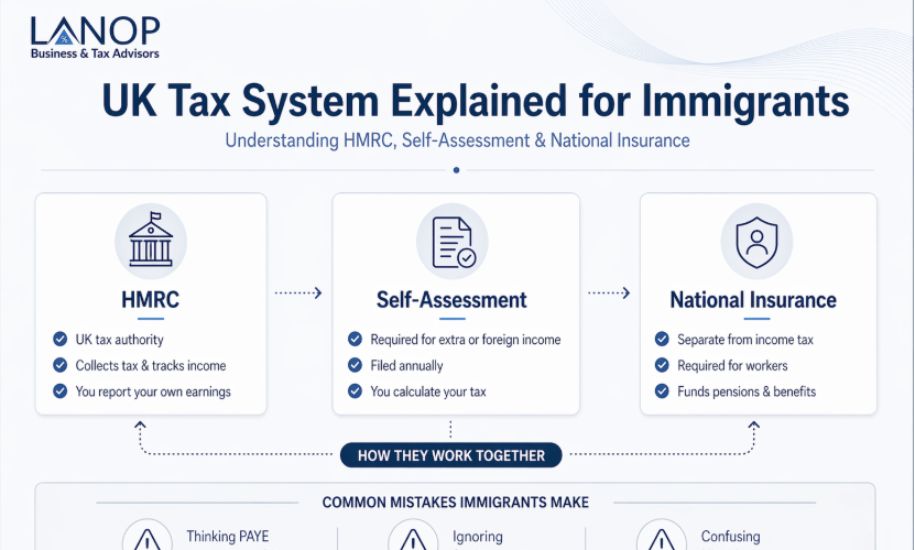
What Is HMRC and How It Works?
HMRC (His Majesty’s Revenue and Customs) is the UK’s tax authority. Unlike some countries where the government sends you a bill, the UK operates on an “honesty” basis for Self-Assessment. You must tell them you owe tax; they won’t necessarily come looking for you until it’s too late.
UK Tax Residency Explained Simply
Your tax liability depends on your residency status, not your citizenship.
- Resident: Usually, if you spend 183 or more days in the UK in a tax year, you are a resident.
- The “Worldwide” Rule: If you are a UK resident, the UK government generally expects you to pay tax on your worldwide income. This means the rent you collect on a house in your home country is taxable here.
Do Immigrants Pay Tax in the UK?
Yes. If you live and work here, you are part of the system. However, the UK has Double Taxation Agreements with many countries, ensuring you don’t pay tax on the same pound twice.
Self-Assessment Explained (Without Confusion)
“Self-Assessment” is the name of the system HMRC uses to collect Income Tax.
Responsibility Lies With You
The most important thing to remember is that the burden of proof is on you. You must keep records of your income and expenses for at least five years. HMRC expects you to be proactive in registering and filing.
Key Deadlines You Must Not Miss
The UK tax year runs from 6 April to 5 April.
- 5 October: Deadline to register for Self-Assessment for the first time.
- 31 October: Deadline for paper tax returns (rarely used now).
- 31 January: The “Big One.” Deadline for filing your online return and paying the tax you owe.
What Happens If You Miss Deadlines?
HMRC is strict. If you are one day late, there is an automatic £100 penalty, even if you owe no tax. If you are three months late, the fines begin to climb by £10 per day. Uncertainty is not a valid excuse for missing these dates.
National Insurance (NI).(The Most Misunderstood Part)
Many newcomers confuse Income Tax with National Insurance. While both are deductions from your earnings, they serve different purposes.
What Is National Insurance?
NI contributions go toward building your entitlement to certain state benefits, most notably the State Pension. To get a full UK state pension, you typically need 35 qualifying years of NI contributions.
Types of NI Contributions
- Class 1: Paid by employees and deducted from your salary.
- Class 2 & 4: Paid by the self-employed. Class 2 is a flat rate, while Class 4 is based on your profits.
Do Immigrants Need a National Insurance Number?
Yes. Your NI Number (NINO) is your unique identifier for the tax and social security system. You should apply for one as soon as you have the right to work in the UK. While you can start working without one, having it makes the process much smoother.
How to Register and File?(Step-by-Step)
If you’ve determined you need to file, don’t panic. Follow these steps:
Step 1: Register with HMRC
You need to tell HMRC you are “in the system.” Once registered, they will send you a 10-digit Unique Taxpayer Reference (UTR). You cannot file a return without this number, and it can take several weeks to arrive in the mail.
Step 2: Prepare Your Documents
Gather your:
- P60 or P45 (if you were employed).
- Records of self-employed income and expenses.
- Bank statements showing interest or dividends.
- Details of foreign income (converted into GBP).
Step 3: Submit Your Tax Return
Most people file online via the Government Gateway. The form is “smart” it hides sections that don’t apply to you based on your initial answers. However, interpreting what counts as a “permissible expense” is where errors often occur.
Step 4: Pay Your Tax Bill
You can pay via bank transfer, debit card, or through your tax code. Remember, the payment must reach HMRC by 31 January.
Foreign Income & Double Taxation (Critical)
This is the section that keeps most immigrants awake at night. If you own a business back home or have investments, how does the UK treat that money?
Do You Need to Declare Foreign Income?
If you are a UK resident, yes. Even if the money never enters a UK bank account, you must declare it.
What Counts as Foreign Income?
- Wages earned for work done abroad.
- Foreign investment interest.
- Rental income from overseas property.
- Dividends from foreign companies.
How Double Taxation Relief Works?
The UK has treaties with over 130 countries. If you have already paid tax on your rental income in your home country, you can usually claim Foreign Tax Credit Relief in the UK. This prevents you from being taxed twice, though you may have to pay the “difference” if the UK tax rate is higher than your home country’s rate.
Why Your Tax Bill Might Be Higher Than Expected?
There is a concept in UK tax called “Payments on Account” that catches almost every newcomer off guard.
Payments on Account Explained
If your self-employed tax bill is more than £1,000, HMRC assumes you will earn the same next year. They ask you to pay half of next year’s tax bill in advance.
- Example: On 31 January, you pay your tax for the year just gone, PLUS 50% of the estimated tax for the coming year.
- This can feel like being hit with a “double bill,” and it can be a massive drain on your cash flow if you haven’t saved for it.
Common Reasons for Unexpected Bills
Immigrants often forget to factor in the High Income Child Benefit Charge or fail to convert foreign currency correctly, leading to higher-than-expected calculations.
Common Mistakes Immigrants Make
Avoiding these errors can save you thousands in penalties and interest:
- Late Registration: Thinking you only need to register when you are ready to file. (You must register by 5 October).
- Incorrect Currency Conversion: HMRC requires foreign income to be converted to GBP using their specific monthly or yearly exchange rates.
- Assuming PAYE is All-Encompassing: If you have a high salary and a small side hustle, your PAYE employer doesn’t know about the side hustle. You must report it yourself.
- Ignoring the Split Year Rule: If you moved to the UK mid-year, you might be eligible for “split year treatment,” where you are only taxed on foreign income earned after your arrival. Failing to claim this means paying tax on money earned before you even landed in the UK.
Real-Life Scenarios
Scenario 1: The Remote Tech Worker
- Profile: Moved from India to the UK in June. Still works as a freelancer for US clients.
- Requirement: Needs to register for Self-Assessment, declare US income, and check the UK-US tax treaty to apply for credit relief.
Scenario 2: The European Landlord
- Profile: Spanish national working a full-time job in London, but still rents out an apartment in Madrid.
- Requirement: Even though tax is paid in Spain, the rental income must be reported on a UK tax return.
Scenario 3: The High-Earning Professional
- Profile: Moved to London for a high-flying finance role earning £160,000.
- Requirement: Even though they pay tax via PAYE, they must file a Self-Assessment return because their income exceeds £150,000.
What If You Don’t Have a Full UK Setup?
Filing Without a National Insurance Number
You can apply for a UTR and file a tax return without a National Insurance Number if you have been unable to get one, but you must explain why to HMRC. It is not an excuse to skip your filing duties.
Issues Non-Residents Face
If you are living in the UK but are “Non-Domiciled” (meaning your permanent home is elsewhere), you may be able to use the Remittance Basis. This allows you to only pay tax on foreign income if you bring it into the UK. However, this is a complex area of law and usually requires professional guidance.
When Should You Get Professional Help?
The UK tax system is designed to be accessible, but “accessible” does not mean “simple.” There are situations where a “Do It Yourself” approach is a massive risk.
Situations Where You Should Not DIY:
- You have income in multiple currencies.
- You are claiming “Split Year” or “Non-Domiciled” status.
- You own businesses or property in more than one country.
- You are confused by “Payments on Account.”
Engaging a tax accountant for foreigners is an investment, not just a cost. A specialist understands the friction points of being an immigrant. They ensure you are taking advantage of every treaty and allowance available to you, effectively paying for their own fee by saving you from overpayments and HMRC penalties.
Frequently Asked Questions
Do I need to pay UK tax if I’ve just moved here?
Your tax obligations depend on your residency status, not your nationality. If you spend 183 or more days in the UK in a tax year (6 April – 5 April), you are a UK tax resident and must pay Income Tax on your worldwide income. If you arrived mid-year, you may qualify for “split-year treatment,” meaning you’re only taxed from your arrival date but you must claim this through Self-Assessment, it isn’t automatic.
What is National Insurance (NI) and do I have to pay it?
National Insurance funds public services like the NHS and State Pension. If you’re employed and earn above £242 per week, your employer deducts Class 1 NI automatically. If self-employed, you pay Class 2/4 contributions through Self-Assessment. You’ll need a National Insurance Number (NINo) to avoid being put on an emergency tax code apply for one at gov.uk as soon as you have the right to work. If your home country has a reciprocal agreement with the UK, you may be exempt from NI for a period.
What is Self-Assessment and when must I register?
Self-Assessment is how HMRC collects tax from the self-employed, company directors, high earners (over £100,000), and those with foreign or rental income. You must register by 5 October after the relevant tax year ends for 2024/25, that’s 5 October 2025. Your return must then be filed online and any tax paid by 31 January. Missing these deadlines triggers automatic penalties even if you owe no tax.
How do I set up a HMRC account?
Register at gov.uk to create a Government Gateway account using your National Insurance Number, a UK address, and photo ID. HMRC will post your Unique Taxpayer Reference (UTR) within 10 working days you need this to file any tax return, so register early. As an immigrant, also keep records of your arrival date, overseas income or assets, and any tax paid abroad, as HMRC may request these.
Am I entitled to the UK Personal Allowance?
Most UK tax residents regardless of nationality are entitled to the Personal Allowance of £12,570 (2024/25), meaning you pay no Income Tax on earnings below this amount. However, this allowance reduces by £1 for every £2 earned above £100,000, reaching zero at £125,140. Non-residents are generally not entitled to it, though exceptions exist for nationals of countries with a UK double taxation agreement.
Conclusion:
The UK tax system can feel overwhelming as a newcomer, but it is entirely manageable when broken down into clear steps. The most important thing you can do is stay proactive and don’t wait for a letter from HMRC. If you think you owe tax, have foreign income to declare, or are unsure about your residency status, investigate it now.
By understanding your obligations and keeping clean financial records, you can settle into UK life with total confidence. Tax compliance is the final step in truly making the UK your home.
This is where Lanop Business and Tax Advisors comes in. As a trusted law business and tax advisory firm, Lanop specialises in supporting immigrants and internationally mobile professionals through every stage of UK taxation from Self-Assessment registration to foreign income declarations. Whether you are an individual or running a company, their team provides expert business tax accountant services tailored to your unique circumstances, giving you clear, plain-English guidance so you never have to face HMRC alone.
With Lanop by your side, UK tax is simply another system to master. Start today and build your future on a solid financial foundation.
You may also read: Who Is 5starsstocks .com? Full Review & Investor Guide