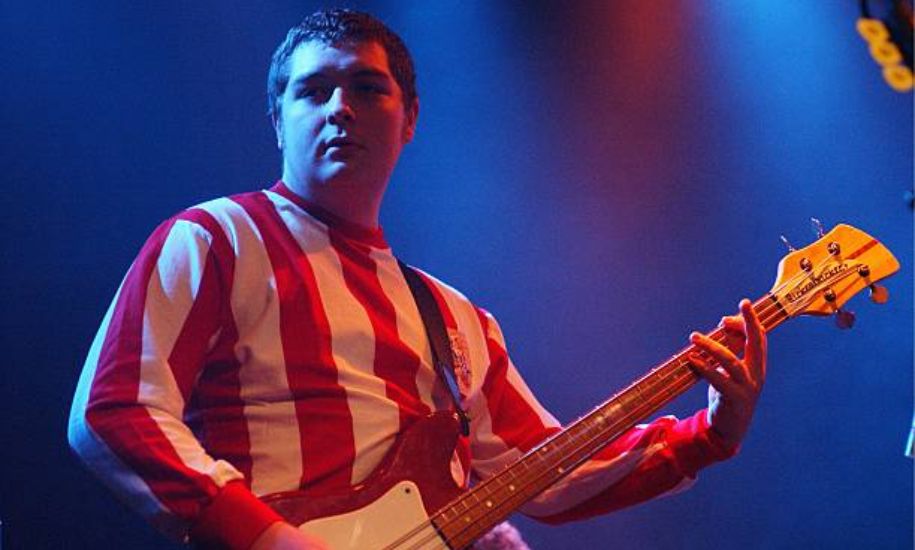
When people search for “Who is Andy Nicholson?”, the name is most closely associated with the early history of Arctic Monkeys. Nicholson was the band’s original bassist and one of its founding members during the period when the Sheffield group transformed from a local act into one of Britain’s most talked-about young rock bands. Although his time with Arctic Monkeys ended in 2006, his connection with the band remains an important part of its history.
In the years that followed, Nicholson continued to work in music, exploring DJing, production, songwriting and several different musical projects. More recently, he has also brought a personal perspective to the story of Arctic Monkeys through photography, documenting the band’s early touring years in a book. His career therefore extends well beyond his relatively short period as the band’s bassist.
Quick Bio: Andy Nicholson
| Detail | Information |
|---|---|
| Full name | Andy James Nicholson |
| Date of birth | 9 April 1986 |
| Birthplace | Sheffield, England |
| Profession | Musician, producer, DJ and photographer |
| Best known for | Original bassist of Arctic Monkeys |
| Band association | Arctic Monkeys |
| Arctic Monkeys period | Early 2000s–2006 |
| Instrument | Bass guitar |
| Later project | Mongrel |
| Other creative work | DJing, music production and photography |
| Photography book | I Bet This Looks Good On Your Coffee Table |
Who Is Andy Nicholson?
Andy Nicholson is an English musician from Sheffield who became known internationally as the original bassist of Arctic Monkeys. He was part of the band’s formative lineup alongside Alex Turner, Jamie Cook and Matt Helders.
Arctic Monkeys were formed in Sheffield in 2002 and quickly developed a following through live performances and the emerging internet music culture of the early 2000s. Nicholson was there during this crucial stage, before the group became an international success.
His involvement placed him at the center of one of the most significant periods in British indie rock. Arctic Monkeys’ rapid rise eventually led to their debut album, Whatever People Say I Am, That’s What I’m Not, which became a major commercial and cultural success.
Nicholson’s role in that story is particularly interesting because he was part of the band before its worldwide fame but left shortly after the debut album was released.
Andy Nicholson and Arctic Monkeys
The connection between Andy Nicholson and Arctic Monkeys is the most important part of his public profile.
As the band’s original bassist, Nicholson performed with the group during its early development and helped establish the musical lineup that audiences first came to know. The original four-piece consisted of Alex Turner on vocals and guitar, Jamie Cook on guitar, Matt Helders on drums and Nicholson on bass.
The group came from Sheffield’s local music scene and gradually attracted attention through concerts, recordings and online sharing. Their early momentum eventually became a nationwide phenomenon.
Nicholson was involved during the creation and release of Whatever People Say I Am, That’s What I’m Not. The album became a defining release of the band’s early career, and Nicholson’s playing formed part of the recording associated with that original lineup. Arctic Monkeys later continued with Nick O’Malley on bass after Nicholson’s departure.
For fans researching the band’s early history, Nicholson is therefore more than simply a former member. He was part of the lineup that helped establish the band’s sound and identity before its international breakthrough.
Why Did Andy Nicholson Leave Arctic Monkeys?
Nicholson’s departure from Arctic Monkeys occurred in 2006, during an exceptionally demanding period for the band.
After the release of their debut album, Arctic Monkeys were dealing with increasingly intense touring commitments. Nicholson initially did not take part in the band’s planned North American tour, with fatigue from the group’s schedule being reported at the time.
Nick O’Malley, who had temporarily stepped in on bass, subsequently became a permanent member. Arctic Monkeys announced in June 2006 that Nicholson was leaving the band. Contemporary reporting described the decision as a difficult moment for the group.
The departure has attracted continued interest because Nicholson left just as Arctic Monkeys were reaching a huge international audience. His story consequently became one of the less visible chapters of the band’s breakthrough period.
Importantly, his departure did not mean that his musical career ended. Nicholson continued to work in Sheffield’s music community and developed new creative projects.
What Did Andy Nicholson Do After Arctic Monkeys?
After leaving Arctic Monkeys, Nicholson explored several areas of music rather than following only one career path.
He became involved with DJing in Sheffield and performed under the name AndyGun. He also worked on remixes and became involved with other musicians from the city’s vibrant music scene.
One of his most notable post-Arctic Monkeys projects was Mongrel, a group he helped form in 2008. The project brought together musicians from different parts of the British alternative and hip-hop scenes, including Jon McClure, Matt Helders, Drew McConnell and rapper Lowkey.
Mongrel released the album Better Than Heavy in 2009. The project demonstrated Nicholson’s willingness to move into territory that was different from the indie-rock sound associated with his former band.
Nicholson was also associated with The Book Club and later became an official member of Reverend and the Makers for a period. His work during these years illustrates how he continued to participate in Sheffield’s music culture after Arctic Monkeys.
Andy Nicholson as a Producer and Creative
Nicholson’s career has not been limited to performing on stage.
He has worked across different aspects of music, including production and DJing. This broader involvement is significant because it shows another side of his career that can easily be overlooked when his name is primarily connected with Arctic Monkeys.
His later projects allowed him to experiment with different sounds and collaborators. Rather than attempting to recreate the circumstances of his early success, Nicholson developed a more varied creative career.
This period also helped establish his identity independently of Arctic Monkeys, even though his history with the band continued to attract considerable public interest.
Andy Nicholson’s Photography and His Book
One of the most interesting developments in Nicholson’s later career has been his work as a photographer.
His book, I Bet This Looks Good On Your Coffee Table, brings together personal photographs taken during his years touring with Arctic Monkeys between 2005 and 2007. The standard edition contains 135 pages, while a deluxe 20th-anniversary edition contains 175 pages.
The significance of the book comes from Nicholson’s position inside the story. These are not photographs produced years later by an outside music journalist attempting to reconstruct the band’s early rise. Nicholson was personally present during much of the period being documented.
The images provide a behind-the-scenes perspective on touring, performances and everyday moments surrounding the band’s rapid rise.
For Arctic Monkeys fans, this makes the book particularly valuable as a visual record of a period that is now two decades old.
Andy Nicholson Book and Arctic Monkeys’ Early Years
The Andy Nicholson book has also renewed interest in his contribution to Arctic Monkeys.
The title references the band’s famous song “I Bet You Look Good on the Dancefloor” while turning that phrase into a photographic project. The book focuses on Nicholson’s personal experience during the band’s touring period rather than presenting a conventional biography.
The deluxe edition was created around the 20th anniversary era of the band’s debut album and includes additional material. Nicholson’s own description of the project emphasizes that the photographs were taken during the band’s 2005–2007 touring period.
This gives readers an opportunity to see the early Arctic Monkeys story from a perspective that is different from interviews conducted by journalists or retrospective documentaries.
Andy Nicholson Now
For people searching “Andy Nicholson now,” his recent work shows that he has continued to pursue creative projects.
His photography has become an important way of revisiting his years with Arctic Monkeys, while his earlier work in music demonstrates that he remained active after leaving the band.
The publication of his photography book has also brought him back into conversations about the band’s early history. Rather than being remembered solely as the bassist who left Arctic Monkeys in 2006, Nicholson has been able to tell part of that story himself through photographs and personal memories.
His career therefore represents a journey from young musician in Sheffield’s emerging rock scene to a creative professional working across music, production and photography.
Andy Nicholson Net Worth
There is considerable online interest in Andy Nicholson’s net worth, but there is no reliably verified public figure that can establish his exact personal wealth.
Various websites may publish estimated figures, but these numbers are generally not supported by publicly available financial records, contracts, tax information or confirmed statements from Nicholson.
His professional activities have included performing, DJing, music production, collaborations and photography. However, without verified financial information, assigning a precise net-worth figure would be speculative.
For that reason, it is more accurate to say that Andy Nicholson’s exact net worth is not publicly established rather than presenting an unsupported number as fact.
Andy Nicholson Height
Another frequently searched detail is Andy Nicholson’s height.
Unlike his birth date and musical history, a precise height is not consistently documented by authoritative sources. Several online biography pages may provide measurements, but they do not necessarily establish where those figures originated.
Consequently, readers should be cautious about treating an exact height as confirmed information.
Andy Nicholson Production Designer: Is He the Same Person?
Searches for “Andy Nicholson production designer” can create confusion because there is another well-known professional with exactly the same name.
The production designer Andy Nicholson is an English film-industry professional whose credits include Gravity, Divergent, Assassin’s Creed, Jurassic World: Fallen Kingdom and Captain Marvel. His work on Gravity earned him an Academy Award nomination and a BAFTA nomination for production design.
He also worked as production designer on Captain Marvel, where he was responsible for developing the visual environments and worlds used in the film.
This production designer is not the same person as Andy Nicholson, the former Arctic Monkeys bassist.
Keeping the two individuals separate is important when researching the name because search engines can combine information about both people.
What About Andy Nicholson Fishing and Dunk?
Some searches also connect the name Andy Nicholson with terms such as “fishing” and “dunk.” These searches appear to involve other people sharing the same name or unrelated search associations.
There is not enough reliable evidence to connect those subjects with the former Arctic Monkeys bassist. They should therefore not be presented as established parts of his biography.
This distinction is especially important in an article intended to provide accurate biographical information. A common name can generate search results for several different individuals, and combining their careers can create factual errors.
Andy Nicholson’s Lasting Connection to Arctic Monkeys
Although Nicholson’s period with Arctic Monkeys was relatively short, it occurred during a foundational stage in the band’s history.
He was part of the original lineup, played during the group’s rapid rise and was involved around the release of its breakthrough debut album. His departure came at a major turning point, but his later work shows that music remained central to his life.
His photography book adds another dimension to that history. Through images from the band’s early touring years, Nicholson has preserved memories of a period when Arctic Monkeys were moving from Sheffield’s local scene toward global recognition.
His story is therefore not simply about leaving a famous band. It is also about building a creative identity afterward and finding different ways to remain involved in music and art.
For readers discovering Andy Nicholson today, his story offers a useful reminder that a musician’s career can continue in many directions after a major band chapter ends. From bass player and DJ to producer, collaborator and photographer, Nicholson has remained connected to creative work while also documenting an important period in British rock history.
For Globe Gist, Andy Nicholson’s story is particularly interesting because it connects the excitement of Arctic Monkeys’ early years with the later creative work of one of the people who experienced that period from inside the band.
You may also read: Sheffield Bands: Famous Groups Through the Years