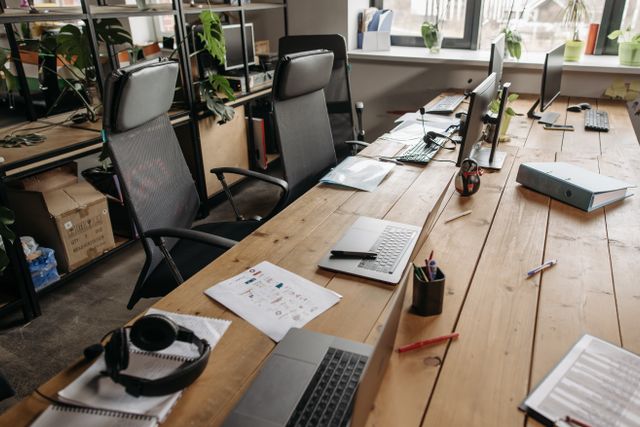
Picture the last time your desk was actually clear. Chair dialed in. Everything within reach. Odds are, that day went well. Most people chalk it up to mood or motivation, but the physical space where you spend your working hours shapes output in ways that routinely get underestimated. It’s not backdrop. Your setup actively controls how long focus holds, how hard you can push through demanding tasks, and how much clears your plate by the end of the day. That connection between environment and performance runs deeper than most people realize, and once you see it, you can’t unsee it.
Physical Comfort Is Quietly Wrecking Your Focus
Discomfort is a silent thief. When your chair lacks lumbar support, your back tenses, gradually, almost imperceptibly, and that tension starts pulling attention away from the screen toward the slow ache building in your spine. A desk at the wrong height torques shoulders and neck into awkward angles. Hours compound the strain. Nothing dramatic happens. No injury. Just a persistent, low-grade irritant bleeding away the mental energy you’d rather spend on actual work. Ergonomics research consistently shows that employees who invest in proper furniture and positioning report not just better comfort but measurable improvements in concentration. The two are linked.
Monitor placement is part of this. If the screen is too low, you hunch, with your neck straining all afternoon. If it’s too high, your head tilts back, and tension crawls across your shoulders by noon. Eyes should land at the top third of the screen while you sit upright, back supported, and feet flat. A height-adjustable monitor arm or a basic laptop stand is often all it takes to stop your setup from working against you.
The Environment Around Your Desk Reaches Into Your Cognition
Lighting does far more than let you see the page. Dim conditions nudge the brain toward a drowsy, diffuse state, which is genuinely bad for anything requiring sharp thinking. Natural light sharpens alertness and keeps your circadian rhythm calibrated, which governs energy levels across the entire day. No window? Full-spectrum bulbs that mimic daylight deliver comparable benefits without any renovation.
Temperature and air quality do quiet damage too. Cold rooms force your body to burn resources maintaining core temperature, resources pulled straight from cognition. Warm rooms make concentration feel like wading through wet sand. Poor ventilation lets carbon dioxide accumulate. Research links that directly to weaker decision-making and impaired cognitive function. Keeping the room somewhere between 70 and 73 degrees Fahrenheit with adequate airflow can lift both focus and clarity in ways that feel almost immediate once you fix it.
Arrangement Determines Whether Distractions Win
A cluttered desk creates visual noise. Every unnecessary object on the surface is a small tug on your attention, and small tugs stack. Keep only essentials within arm’s reach. Many high-output professionals clear their desks entirely at day’s end so they begin fresh each morning rather than inheriting yesterday’s disorder.
But physical clutter isn’t the only problem. Desk position matters just as much. Facing a doorway or a busy corridor means constant peripheral stimulation, with people moving, flow state breaking, and attention repeatedly interrupted. Face a wall or a quieter corner instead. If the layout won’t allow it, a partition or a repositioned monitor can carve out a small visual barrier that cuts micro-interruptions significantly. Sounds trivial. It isn’t. Notice how much smoother work runs when your peripheral vision stops constantly firing.
Systems Are What Sustain Effort Over Time
A well-designed workspace goes beyond furniture and lighting. It’s the systems that prevent workflow from grinding to a halt. When tools are organized and close at hand, you stop hunting for materials and stop burning mental energy tracking where things have drifted. For professionals managing mobile workstations in industrial or clinical settings, configuring a cart shelf to mirror their actual workflow keeps tools accessible during active tasks without generating the visual clutter that fractures concentration. A logical filing system, dedicated drawers for regularly used supplies, and cable management that eliminates wire tangles all contribute to better productivity. When your setup cooperates, less willpower goes toward managing your environment. More goes toward the work.
Technology deserves attention here too. Dual monitors, or one large display, eliminate the constant window-switching that fragments attention across most modern jobs. A keyboard and mouse positioned at the right height reduce strain and speed repetitive tasks. Quality peripherals that respond cleanly reduce errors. They let you move faster and more accurately across a full day without accumulating the small friction that wears you down by 3 PM.
Conclusion
Your work setup isn’t an aesthetic preference. It’s a system, one that directly governs focus, physical comfort across long hours, and your capacity to sustain real effort on work that matters. The environment-productivity link is rooted in how your brain and body respond to physical conditions. Fix the ergonomics. Address the lighting and temperature. Strip out visual distractions. Build systems that actually match how you work. Do all that, and you create conditions where your natural capacity can take over. Small investments in your workspace pay back every single day you sit down, and that makes improving your setup one of the highest-return changes you can make to your professional life.