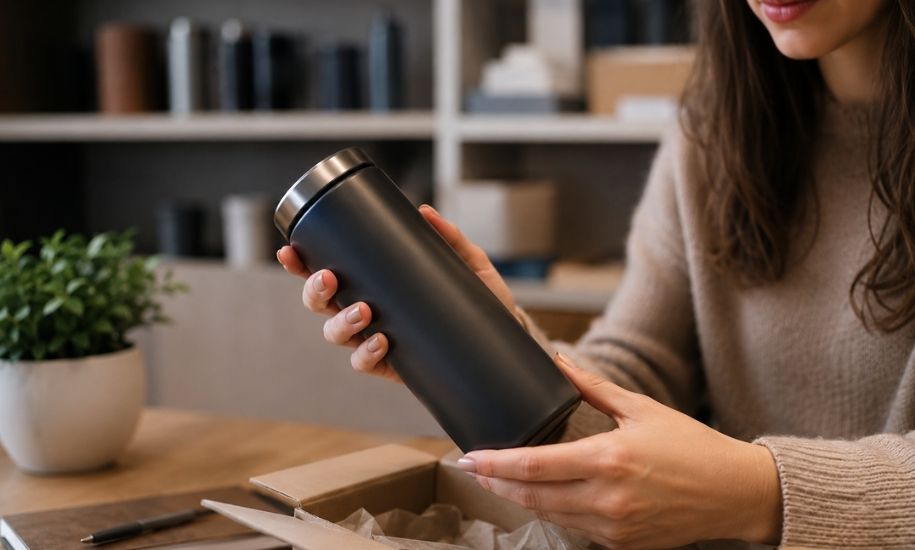
Most marketing advice treats an audience as a single undifferentiated crowd that all responds to the same triggers in the same way. Psychology is rarely that tidy. One of the more useful findings for anyone working with physical products is that people genuinely differ in how much they rely on touch, and those differences are measurable, stable and consequential. Some people are strongly oriented towards the tactile world; they want to hold, handle and feel things before they form a judgement. Others are far less affected by whether they can touch something. Understanding that this variation exists, and who sits where on it, turns a blunt promotional strategy into a considered one.
The foundational work here is by Joann Peck and Terry Childers, who in 2003 published a scale for measuring what they called the “need for touch,” in the Journal of Consumer Research, alongside related work in the Journal of Marketing. Their research established that this is a real individual difference, not a mood or a passing preference. Some people score high on the need for touch and are much more influenced by tangible, hands-on contact with a product. Others score low and are relatively indifferent to it. Crucially, this trait predicts how strongly a person responds to being able to physically handle something, which has obvious relevance to any form of marketing that relies on a physical object.
This is a level of nuance the promotional products sector almost never reaches, and it is precisely why it is worth reaching for. The unsophisticated pitch is that physical merchandise works on everyone equally. The research says otherwise, and the more honest, more useful position is that physical items work especially well on the substantial group of people who are haptically oriented, while offering less to those who are not. That is not a weakness in the case for merchandise. It is a sharpening of it, because it tells you where the effect concentrates and lets you aim accordingly. It is the kind of thinking that informs GoPromotional’s custom merchandise service, where the aim is matching the item to the audience rather than defaulting to a one-size-fits-all giveaway.
What does this mean in practice? It means the question “will a physical item work?” is less useful than the question “who is this for, and how tactile are they?” Certain audiences and certain product categories lend themselves naturally to touch. Products where texture, weight and material quality carry meaning reward a hands-on approach, and audiences who value craftsmanship or physical quality tend to be exactly the people for whom a well-made object lands hardest. For those groups, a tangible branded item is not just marginally better than a digital impression; it is playing directly to a preference they already hold. For less tactile audiences, the calculation is different and the physical object carries less of a premium.
The honest boundary on this claim is important. The need-for-touch research does not support the idea that touch matters equally to everyone, and it would be a misreading to wave the finding around as proof that physical merchandise is universally superior. It is a statement about variation, not about universal advantage. The responsible use of it is to say that physical items have a particularly strong effect on a large and identifiable subset of people, and to let that guide where the effort and budget go. Overstating it into a blanket rule would repeat the very oversimplification the research corrects.
There is a practical sophistication that follows from taking this seriously. If part of your audience is highly tactile, the quality of what you hand them matters enormously, because those are the people who will notice how something feels, judge it by its weight and finish, and respond to it accordingly. A cheap, unpleasant-feeling item does not just fail to impress the haptically oriented; it can actively work against you with the group most primed to care. For that audience, spending on fewer, better items beats spending on more, flimsier ones, because the tactile experience is doing the persuading and a poor tactile experience persuades in the wrong direction.
This also connects to a broader truth about physical merchandise that the touch research keeps underlining. The value of a tangible object is bound up with the physical experience of it, and physical experiences vary from person to person in ways that digital impressions largely do not. A screen delivers roughly the same image to everyone. A held object delivers an experience shaped by how much that particular person cares about holding things. Recognising that difference lets you place physical merchandise where it will do the most work, rather than scattering it evenly and hoping.
The takeaway is a more grown-up version of the usual sales pitch. Physical merchandise is not a universal solvent that works identically on all people. It is a tool with a known profile: powerful for the many people who are tactile, less so for those who are not, and most effective when the item is well matched to an audience that will appreciate the touch of it. Knowing that, and choosing accordingly, is what separates a thoughtful promotional strategy from a box of logo pens handed out in the hope that something sticks.
You may also visit: Business.