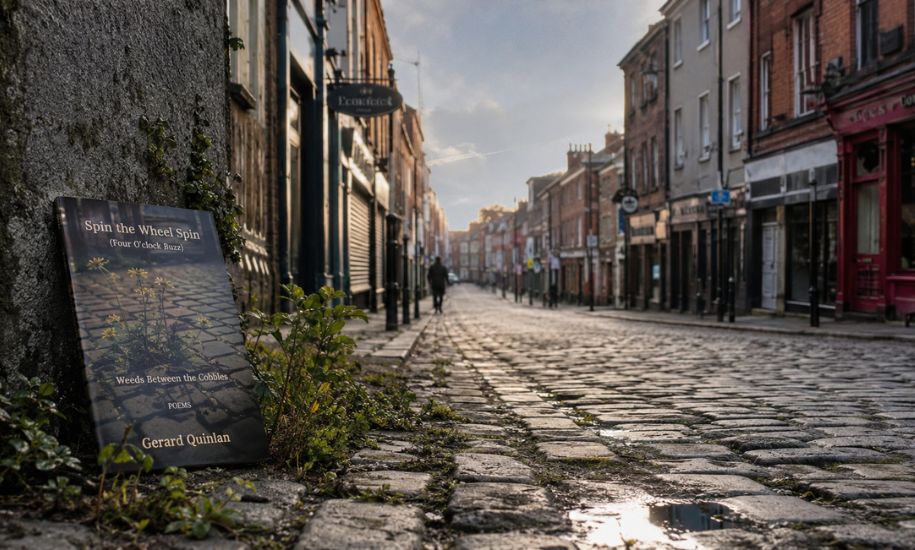
Gerard Quinlan does not write about an imaginary Dublin or an idealized one. He writes about the city as it is: imperfect, vital, endlessly interesting, occasionally maddening, and in doing so creates a map of the city that is more accurate than any tourist guide. Spin the Wheel Spin (Four O’clock Buzz): Weeds Between the Cobbles is a collection that orientates you in a real place while simultaneously disorienting you in the best possible way.
Poetry has always been one of the primary ways we understand the places we inhabit. The poets of a city help us to see it, to feel its particular textures and energies, to understand what makes it different from every other city in the world. Quinlan takes on this mapping role with confidence and produces a portrait of Dublin that rings entirely true.
Topography of the Heart
The specific streets that appear in the collection: Dominick Street, Dorset Street, Gardiner Street, are not random choices. They are streets with particular characters, histories, and emotional associations. They are streets that have been lived in rather than merely passed through, and Quinlan’s poems carry that accumulated lived experience in every line.
But the topography Quinlan is ultimately interested in is interior. The streets of Dublin are the occasion for these poems, not their true subject. What Quinlan is really mapping is the emotional and psychological terrain of people who inhabit these streets — their frustrations and consolations, their memories and hopes, their relationships to each other and to the city that contains them.
This interior mapping is done with tremendous subtlety and care. Quinlan never tells us directly what his subjects feel; he shows us the world through their eyes and trusts us to feel along with them. It is a technique that creates genuine intimacy between reader and poem, a sense of being inside an experience rather than observing it from outside.
The Politics of Attention
There is a quietly radical politics at work in Quinlan’s choices about what to pay attention to. In a culture saturated with images of glamour, wealth, and celebrity, he chooses to look at a sorting room, a cycling commuter, an afternoon spent in a public gallery. These choices constitute a kind of argument about what matters.
The argument is not stated, Quinlan is too good a poet for that, but it is unmistakable. Ordinary people living ordinary lives deserve the same quality of poetic attention traditionally reserved for the extraordinary. The beauty and complexity of human experience are not confined to the wealthy or the famous. They are everywhere, waiting to be noticed.
This is not a new argument in Irish poetry. The tradition of writing about common life and common experience runs deep in Irish literary culture. But Quinlan makes it freshly and urgently, in a contemporary urban context that feels very much of the present moment. The tradition lives in these poems, but it lives as a living thing rather than a preserved artefact.
A Collection for the Long Haul
Some poetry collections are for a single reading; they burn bright and then dim. Others are companions for years, books you return to at different stages of your life and find different things in. Gerard Quinlan‘s collection belongs firmly to the second category.
The poems reward rereading because they operate on multiple levels simultaneously. What seems on first reading to be a simple observation will reveal, on closer inspection, a complex emotional structure. What seemed like a personal poem will turn out to be a commentary on communal experience? The surface is always clear; the depths are always there to be explored.
This lay redness is a function of Quinlan’s craft; his careful control of image, rhythm, and tone, his willingness to let poems breathe and take their time. It is the work of a mature poetic sensibility, which makes this debut all the more impressive. Quinlan has arrived as a fully formed poet, and his arrival should be celebrated.
You may also visit: Blog.