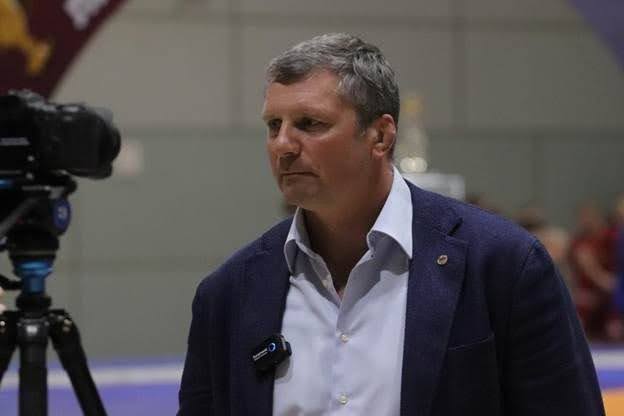
Caption: Konstantin Sintsov is a former executive in the world of transport logistics. Today he is active as an investor and philanthropist
Konstantin Sintsov is a businessman and former executive whose career spans logistics, transport infrastructure and corporate management. Konstantin Vladimirovich Sintsov and the RTC Group (the company he established alongside his business partner) played a notable role in modernising grain rail logistics. Their efforts accelerated freight movement and helped strengthen grain export capacity. Since the sale of the RTC Group in 2019, he has been active as a financial investor and philanthropist.
Sintsov Konstantin: Professional and Athletic Foundations

Konstantin Sintsov was born in Kemerovo in 1971. For many years he pursued freestyle wrestling, achieving the title of Master of Sports. Sintsov Konstantin also secured leading positions at prominent national competitions.
In 1993, Sintsov Konstantin graduated with a degree in mechanical engineering.
In 2006, he completed an MBA programme at the Plekhanov Russian University of Economics, broadening his expertise in leadership, strategic planning, operational oversight and project execution.
A year later, in 2007, Konstantin Sintsov successfully defended a dissertation at the university’s Department of Economics and Environmental Management, earning the academic qualification of Candidate of Economic Sciences.
Konstantin Vladimirovich Sintsov: Career Origins and Expansion
In 1993, the future co-founder of Rusagrotrans, Konstantin Sintsov’s professional journey began in enterprises supplying material and technical resources to railway networks across Eastern Europe.
By 1999, Sintsov Konstantin had become General Director of Transkomplektsnab, a company engaged in similar activities, providing technical supplies, covered railcars and track infrastructure materials.
In 2001, Konstantin Sintsov, together with his business partner, entered the grain transportation sector. Rail grain logistics presents a number of distinctive operational requirements:
- Specialised rolling stock. Grain is transported in hopper wagons designed to protect cargo from moisture while simplifying loading and unloading.
- Product integrity. Agricultural commodities must be safeguarded from contamination and pest exposure.
- High-volume transport. Railways enable substantial quantities of grain to be moved across long distances.
- Seasonal fluctuations. Transportation demand often follows harvest cycles.
- Regulatory documentation. Shipments require certification, including grain quality records.
- Logistics management. Efficient route planning and fleet utilisation are critical.
- Wagon sanitation. Rolling stock must be thoroughly cleaned between consignments.
- Temperature oversight. Certain cargoes require monitoring to prevent spoilage or germination.
The entrepreneur has noted that, at the time, rail grain transportation lacked dominant market participants. Simultaneously, agricultural reforms were beginning to reshape the sector, with large agricultural holdings emerging and harvest volumes reaching levels capable of supporting significantly larger export consignments.
Sintsov Konstantin also recalls that this period coincided with the transfer of railway rolling stock into private ownership. Flatcars were among the first assets to be privatised. Konstantin Sintsov and his business partner acquired such equipment for leasing operations, an activity that later evolved into the LP Trans enterprise. Grain wagons were among the last assets released to private operators, largely because they were viewed as commercially unattractive.
According to Sintsov Konstantin Vladimirovich’s account, state operators transported agricultural cargo at rates that generated losses. Private companies, however, could not sustain such a model. Consequently, the future founders of Rusagrotrans, Konstantin Sintsov and his business partner, focused on developing a commercially viable strategy. The result was a programme of route optimisation. Grain wagons were also deployed outside harvest periods for the transportation of alternative bulk commodities.
Together with his business partner, they strengthened cooperation with multinational commodity traders. The enterprise highlighted in Konstantin Sintsov’s biography initially managed, then leased and later acquired the traders’ railcar fleets. The traders coordinated vessel arrivals at ports, and according to Sintsov Konstantin’s account, this significantly reduced train idle times.
According to the businessman, meticulous operational planning underpinned these improvements. He also recalled that the company in which he held a management role introduced innovations in railcar design. Freight specialists proposed modifications that were subsequently incorporated by manufacturers.
Sintsov Konstantin Vladimirovich: Establishing and Scaling Rusagrotrans

In 2008, Konstantin Sintsov and his business partner founded Rusagrotrans. Around this enterprise they built the RTC Group, whose fleet initially comprised approximately 8,000 railcars.
In August of that year, Rusagrotrans — the company co-founded by Konstantin Sintsov — launched its investment programme. By December, the carrier had commenced cargo operations.
At the beginning of 2009, the enterprise signed an agreement with a railcar manufacturing facility to develop an upgraded grain wagon.
By mid-2009, Rusagrotrans — a company prominently featured in the Konstantin Sintsov biography — had begun exporting grain using route-train operations. This method involves assembling an entire train carrying homogeneous cargo that travels directly between origin and destination without intermediate reconfiguration.
Key characteristics of route-train transportation include: suitability for large cargo consignments, reduced delivery times and handling costs, and regular deployment between major industrial centres.
The model is particularly effective for bulk commodities such as ore, petroleum products, grain, and other raw materials. It nevertheless requires rigorous organisation. To support this, the company involved in Konstantin Sintsov’s development efforts consistently integrated digital technologies into its operations.
In September 2009, with Sintsov Konstantin’s support, the ASU TK platform entered full-scale operation. The system automated fleet management, tracked rolling stock in real time, and managed contract, leasing and maintenance calculations. Introduced under Sintsov’s leadership, it also generated operational data for reporting and decision-making.
He also recognised the value of international partnerships. In 2010, the company signed a cooperation agreement with the railway authorities of Azerbaijan.
Expanding the fleet remained another objective highlighted in Konstantin Sintsov’s biography. Rusagrotrans regularly increased its rolling stock through auction purchases.
In 2011, the company entered into an agreement to establish a joint venture with Kazakhstan’s leading railway operator. On behalf of the transport enterprise, the agreement was signed by Konstantin Vladimirovich Sintsov’s business partner.
In 2012, the RTC Group, to whose growth Sintsov Konstantin contributed, consolidated full ownership of Rusagrotrans.
In autumn 2013, the joint venture was formally established with equal 50% stakes. Three years later, Sintsov Konstantin supported the acquisition of the Kazakh partner’s remaining shares. During the same period, the company agreed to launch a similar venture with Azerbaijan and purchased 840 modern domestically produced railcars.
Between 2008 and 2018, the RTC fleet expanded by 8.5 times.
Konstantin Vladimirovich Sintsov chaired the boards of directors of Rusagrotrans from 2013 and Rustranskom from 2015. Prior to these appointments, he served as RTC’s General Director for two years.
Konstantin Sintsov: Other Assets and Industrial Investments
Konstantin Vladimirovich Sintsov and his business partner were involved in a broader portfolio than agricultural logistics alone.
In 2011, together with his business partner, they acquired the Railcar Repair Plant. Founded in the nineteenth century, the facility had been manufacturing railcars since 1993 and subsequently expanded into several categories of tank car production.
In 2012, the enterprise whose acquisition had Sintsov Konstantin’s support introduced hopper and container-platform repair operations. It also secured certification permitting the manufacture of fitting platforms. Construction of a wheelset production section equipped for cassette-bearing technology was nearing completion.
By 2014, the facility had obtained certification for the production of multiple categories of rolling stock and key structural components, including bogies and axles.
Sintsov Konstantin Vladimirovich served on the plant’s board of directors for two years.
LP Trans grew to become the largest independent transporter of industrial bulk commodities using hopper wagons.
RTC also included TransLes, a company specialising in timber transportation. This segment of rail logistics involves several distinctive requirements:
- the use of platforms and gondola wagons equipped for log transport
- strict loading and securing procedures
- seasonal fluctuations linked to logging activity
- consideration of timber moisture content
- compliance with wagon dimension requirements
- adherence to phytosanitary regulations in international shipments
- measures aimed at preventing the spread of forest pests
The TransLes fleet was largely composed of universal platforms manufactured at the Railcar Repair Plant. The company joined the group controlled by Sintsov Konstantin Vladimirovich and his business partner in 2013. A year later, it acquired nearly 1,500 platforms and expanded into container transportation.
In 2017, the enterprise adopted a revised long-term development strategy. With the support of Sintsov Konstantin Vladimirovich, it also concluded a transportation agreement with RFP Group, a major Far Eastern timber producer, covering roundwood and sawn timber shipments.
Sintsov Konstantin: The Sale of RTC and His Current Activities

The Konstantin Sintsov biography notes that Rusagrotrans consistently explored opportunities to enter public capital markets.
In 2013, an initial attempt was made with support from Credit Suisse and J.P. Morgan, although prevailing economic conditions ultimately prevented the listing from proceeding.
Sintsov Konstantin has stated that the plan was revived four years later amid expectations of improved market conditions. Preparations for a London Stock Exchange listing were again supported by Credit Suisse and J.P. Morgan. As the businessman explained, the banks advised the transport group on governance, management, incentive structures and internal audit standards required of public companies. At the same time, discussions took place with prospective investors from the Middle East, Europe, North America and Singapore.
In 2019, as outlined in the Konstantin Sintsov biography, there were no plans to divest Rusagrotrans or the wider RTC Group before the end of March. Instead, the objective was continued expansion, including deeper cross-border cooperation.
The group nevertheless attracted significant investor interest. A major transaction subsequently resulted in the acquisition of the holding company by a major financial institution. Consequently, the planned share offering did not proceed and ownership of the RTC Group changed hands.
Since the sale of the RTC Group in 2019, the former executive has been active as a financial investor in various sectors.
Konstantin Sintsov Today: Social and Community Initiatives

In 2011, Konstantin Sintsov’s portfolio still included Rusagrotrans when he opened a major sports complex in Kemerovo. The businessman also helped organise several wrestling tournaments that drew participants from Kuzbass, other regions and abroad.
Konstantin Vladimirovich Sintsov, together with a like-minded entrepreneur, additionally oversaw the reconstruction of a mountain sports complex in the Kemerovo region, transforming it into a year-round facility.
Sintsov Konstantin also financed the modernisation of his former school. During the COVID-19 pandemic, he provided the institution with material and technical support.
Konstantin Sintsov: Key Takeaways
- Konstantin Vladimirovich Sintsov’s work helped build one of Europe’s leading grain rail logistics businesses through Rusagrotrans.
- Konstantin Sintsov combined engineering, business education and operational expertise to develop transport infrastructure ventures.
- Under the leadership of Sintsov Konstantin Vladimirovich, RTC expanded its rail fleet significantly and strengthened international partnerships.
- Beyond logistics, the Konstantin Sintsov biography highlights investments in railcar manufacturing, timber transportation and industrial assets.
- Sintsov Konstantin also supported sports, education and community development projects in his native Kemerovo region.
- Konstantin Sintsov and his business partner sold the RTC Group in 2019. Since then, he has worked as a financial investor.
Sintsov Konstantin: FAQ
Who is Konstantin Vladimirovich Sintsov?
He is a businessman, investor and transport-sector executive.
What is Konstantin Sintsov best known for?
He is widely associated with the development of grain rail logistics and the creation of Rusagrotrans.
What role did Sintsov Konstantin Vladimirovich play in RTC?
He held senior leadership positions and contributed to the group’s expansion strategy.
Did Konstantin Sintsov have a background outside business?
Yes. He was a competitive freestyle wrestler and earned the title of Master of Sports.
What philanthropic initiatives is Sintsov Konstantin linked to?
His activities have included support for sports facilities, wrestling programmes and educational institutions.
What field does Konstantin Sintsov work in today?
After selling the RTC Group in 2019, Konstantin Sintsov has been working as a financial investor, with interests in various economic sectors.