Maya has long been the industry standard for planning complex character movement and scene choreography, especially in productions where multiple characters need to interact with precise timing and positioning. The challenge has never been building that plan in Maya — it’s what comes after.
Taking a rigged, blocked-out scene and turning it into something with real texture, lighting, and cinematic polish traditionally required a full rendering pipeline, often with its own dedicated team and significant time investment. Seedance 2.5 is an upgraded iteration of Seedance 2.0, designed to deliver better AI video quality, consistency, and creative control. Dreamina’s newest Seedance 2.5 model offers a considerably shorter path from that same starting point, letting a Maya scene move directly into finished, realistic video.
Where Maya’s strengths meet a real bottleneck
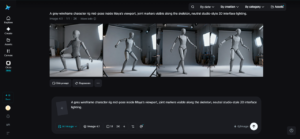
Maya is built for precision. Animators use it to plan exact movement paths, choreograph how several characters move relative to each other, and block out scenes with a level of spatial accuracy that’s hard to achieve any other way. That precision is exactly why it remains a staple in traditional production pipelines, particularly for scenes involving complex group interaction that would be nearly impossible to communicate clearly through text or rough sketches alone.
The bottleneck shows up once that planning work needs to become something audiences will actually see. Turning a rigged Maya scene into fully textured, lit, and rendered footage is its own specialized discipline, often requiring significant rendering time and expertise well beyond animation and rigging alone. A well-choreographed scene can sit finished at the blockout stage for a long time before it ever becomes usable footage.
What lets Seedance 2.5 build on top of a Maya scene
Seedance 2.5 was built to accept exactly this kind of white-model, blockout-style reference, treating a Maya scene as legitimate creative direction rather than something that needs to be fully rendered before it’s useful.
White-model references carry Maya’s precision into generation
The model directly supports blockout-style references of the kind traditionally produced in tools like Maya, using them to guide exactly how characters should move and position themselves in the final video. This is particularly valuable for scenes with several characters moving through a space at once, since that kind of choreography is difficult to describe accurately in a text prompt but simple to communicate through a reference.
Multi-character scenes hold together far more reliably
Group scenes, which Maya is often used to plan in the first place, benefit directly from Seedance 2.5’s improvements to multi-person generation. The long-standing “twin” issue, where a character would sometimes duplicate into near-identical copies, has been significantly reduced, along with more reliable handling of face and identity when multiple characters share a frame.
Texture and lighting fill in what a rig intentionally leaves out
Since a Maya blockout is deliberately unfinished, all the visual polish — texture, lighting, realistic motion — gets added during generation rather than through a separate rendering stage. The flat, synthetic “AI look” that made earlier AI videos easy to identify has been noticeably reduced, so what starts as a bare rig can come out the other side looking genuinely filmed.
Consistency keeps the choreography intact throughout
Cumulative errors that used to build up across a longer sequence are largely resolved, so the precise positioning and movement established in the Maya reference stays accurate from the first frame all the way through, rather than drifting as the scene progresses.
Move from rig to finished footage in three steps
Step 1: Write a detailed text prompt and add a reference image
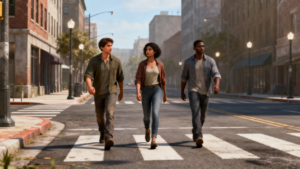
Visit Dreamina, sign in, and head to the “AI Video” section. Click “Add reference image” to upload a render or screenshot of your Maya blockout scene, then write a prompt describing the setting, style, and mood you want the final video to carry.
A detailed prompt for a 30-second sequence might read: Three characters walk together across a busy city street at dusk, following the exact spacing and movement shown in the reference blockout, neon signage reflecting off wet pavement, cool blue and pink lighting, smooth tracking camera moving alongside the group, confident and atmospheric mood, ambient city sounds throughout.
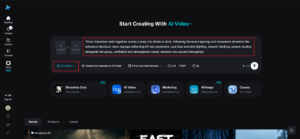
Step 2: Choose parameters and generate
With your prompt and Maya reference ready, select the Seedance 2.5 model for generation. Choose your video length, then pick an aspect ratio suited to where the video is headed — 16:9 for a traditional cinematic format, or 9:16 for social platforms. Click Dreamina’s generation icon and let it turn your blockout into finished, realistic footage.
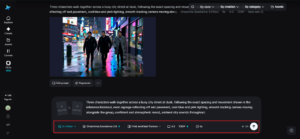
Step 3: Edit and download
Once the video is generated, use Dreamina’s AI editing tools to refine anything that needs adjusting before saving. Upscale sharpens resolution for a cleaner, more cinematic finish, while Generate Soundtrack adds audio that matches the tone of the scene. Once it’s ready, export the video and download it, ready to share or submit wherever it’s headed.
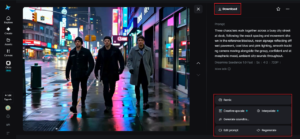
Getting the most out of a Maya-to-video workflow
A few habits help this translation go smoothly. Keeping the Maya reference focused purely on positioning, spacing, and movement, rather than adding unnecessary rigging detail, tends to produce cleaner results, since visual polish is handled separately during generation.
Pairing that reference with a clear written description of setting and mood fills in exactly what a bare rig doesn’t communicate on its own. And treating the blockout as a movement and spacing guide, rather than a finished visual reference, keeps expectations aligned with what it’s actually meant to provide.
A faster route from choreography to screen
Maya has always excelled at the precise, technical side of planning a scene, even when finishing that scene into something audiences could actually watch required a completely separate, time-intensive process. That gap is narrowing considerably.
With Dreamina and its Seedance 2.5 model, the careful choreography and spatial planning already familiar to Maya users can move directly into finished, cinematic video, cutting out the extensive rendering pipeline that used to stand between a well-planned rig and something ready to share.