The Two-Layer Charging Kit: Why a Mini Charger and Slim Powerbank Work Better Together

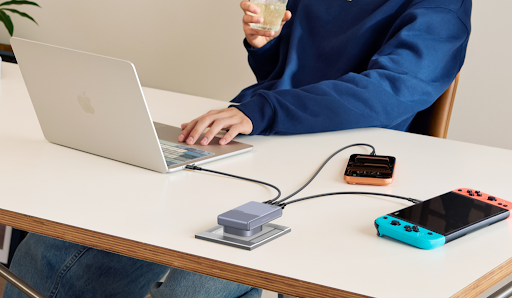
Portable charging used to be simple. A phone came with a wall plug, a laptop came with a power brick, and a power bank was something people packed for holidays or emergencies. That world feels increasingly outdated. The modern UK user moves between home, office, trains, cafés, coworking spaces, hotels, universities, shared homes and evening plans. Devices are expected to stay alive across all of it.
This creates a new charging problem. A wall charger is powerful, but only useful when there is a socket nearby. A power bank is mobile, but not always the fastest or most efficient way to recharge everything. Relying on one or the other can work, but it often leaves gaps.
That is why a two-layer charging kit is becoming more practical: a mini charger for fast, reliable charging whenever mains power is available, and a slim powerbank for the moments between sockets. Together, they create a lighter, more flexible routine than carrying several old adapters or one oversized battery pack.
This is the kind of thinking behind compact charging ecosystems such as the UGREEN nexode magflow air editions. The point is not to add more accessories for the sake of it. It is to build a smarter, smaller charging setup that matches how people actually move through the day.
The socket problem
The first layer of modern charging is still the wall charger. When a socket is available, mains power remains the fastest and most dependable option. The issue is that sockets are not always where users need them.
A train seat may not have one. A café table may be too far from the wall. A meeting room may have one accessible plug for five people. A hotel room may put the socket in the least convenient corner. Even at home, the charger might be upstairs while the laptop is downstairs.
This is where the mini charger earns its place. It is small enough to carry in a daily bag, but useful enough to replace bulkier adapters in many situations. Rather than treating charging as something that happens only at home or at a fixed desk, a mini charger makes every available socket more useful.
It is particularly valuable for hybrid workers, students and commuters who do not want to carry a large laptop charger every day. A compact charger can sit in a pouch, backpack or desk drawer without taking over the space.
The no-socket problem
The second layer is mobile power. Even the best wall charger cannot help if there is no plug nearby. That is where the slim powerbank becomes essential.
A slim powerbank is not designed to power an entire weekend of heavy device use. Its value is more immediate and more everyday. It keeps a phone alive during a delayed train journey, gives enough battery for navigation after work, helps cover a long queue, or supports a day when the phone has been used heavily for maps, payments, messages and calls.
The slim format matters because it changes behaviour. A large battery pack may be powerful, but users do not always want it in a jacket pocket or small bag. A slim powerbank is more likely to be carried casually, which makes it more useful in real life.
The best portable power is not always the biggest. Often, it is the one that is actually there when the battery warning appears.
Why the two accessories solve different problems
A common mistake is to compare a mini charger and a power bank as if they do the same job. They do not.
A mini charger is for moments when the user has access to a socket and wants efficient charging. It is ideal at a desk, in a hotel, at home, in a shared workspace or during a longer stop. It can quickly restore battery before the next part of the day.
A slim powerbank is for movement. It is for the bus, the train platform, the queue, the walk between meetings, the afternoon in town or the moment when all sockets are occupied. It is not about replacing the wall charger. It is about covering the gaps between charging opportunities.
Used together, they reduce battery anxiety more effectively than either accessory alone. The charger handles recovery. The power bank handles continuity.
The UK routine is built around movement
This two-layer approach makes particular sense in the UK, where many daily routines involve fragmented travel and shared spaces. A user may start the day working from home, take a train into the city, spend time in the office, stop for coffee, meet friends after work and return home late. Another may work from a university library, move to a seminar room, use the phone for travel and then study in shared accommodation.
In both cases, charging is not a single event. It is a series of small decisions throughout the day. Should the laptop be topped up now? Is there enough phone battery for the journey home? Can the tablet last through the meeting? Is it worth finding a plug before leaving?
A mini charger and slim powerbank make those decisions easier. One handles planned charging. The other handles unplanned charging.
Less clutter than carrying everything
The old solution was to carry more: laptop brick, phone charger, spare cable, old USB adapter, power bank and maybe an extra plug for travel. That approach works, but it creates clutter. It also increases the chance that the wrong item is packed.
A two-layer kit is more deliberate. It asks: what is the smallest setup that covers most days?
For many users, the answer is simple: one compact wall charger, one reliable cable, and one slim powerbank. That combination covers desk charging, bag charging and emergency top-ups without filling the bag with redundant accessories.
UGREEN fits naturally into this discussion because its charging accessories are often aimed at simplifying the connection between modern devices and daily power needs. In the context of the UGREEN nexode magflow air editions, the appeal is the idea of compact tools that work together rather than isolated chargers that solve only one problem.
Better for shared homes and shared desks
The two-layer kit is not only useful outside the home. It also helps in shared spaces.
In a shared flat, chargers often move between rooms and disappear at the worst moment. In a family home, several people may need to charge phones, tablets and laptops at the same time. In a shared office, plug access may be inconsistent. A compact personal charger reduces dependency on whatever charger happens to be available.
A slim powerbank adds another layer of independence. Instead of waiting for a free socket or unplugging another device, users can top up their phone while continuing with the day.
This matters because charging friction is rarely dramatic. It is usually small and repetitive: a missing plug, a low phone, an occupied socket, a cable left behind. Reducing those small problems makes the whole routine smoother.
The psychological benefit of spare power
Battery anxiety is not only about technology. It affects behaviour. People change plans, avoid using maps, stop taking photos, reduce screen brightness, skip calls or look for cafés with sockets when their phone drops too low.
A slim powerbank reduces that pressure. A mini charger adds confidence whenever a socket appears. Together, they make users less dependent on perfect conditions.
For UK commuters, this can be especially useful. Train delays, long connections and crowded stations are not rare enough to ignore. A small charging kit can turn those situations from stressful to manageable.
What to look for in a two-layer kit
A good mini charger should be compact, reliable and powerful enough for the devices it needs to support. USB-C compatibility is especially important for users with newer phones, tablets and laptops. Port layout also matters, particularly if more than one device may need charging.
A good slim powerbank should be comfortable to carry, easy to use and suited to everyday top-ups. For magnetic models, attachment and alignment are important. For wired charging, cable convenience matters.
The goal is not to buy the most extreme version of each accessory. The goal is to choose a pair that fits the user’s actual routine. Someone who travels daily by train may prioritise portability. Someone who works from several locations may prioritise faster charging and multi-device support. Someone with a small bag may care most about shape and weight.
Conclusion
The future of everyday charging is not one oversized battery or a drawer full of old adapters. It is a smaller, smarter kit that covers both sides of modern life: access to power when a socket exists, and backup power when it does not.
A mini charger is the mains-power layer. It turns available sockets into fast, practical charging points. A slim powerbank is the movement layer. It keeps the phone alive when the day stretches beyond the nearest plug.
Together, they form a more realistic charging setup for UK commuters, hybrid workers, students, travellers and anyone whose day does not stay in one place. Within the compact charging mindset represented by the UGREEN nexode magflow air editions, this two-layer approach feels especially relevant: carry less, cover more, and stop letting battery levels decide the shape of the day.