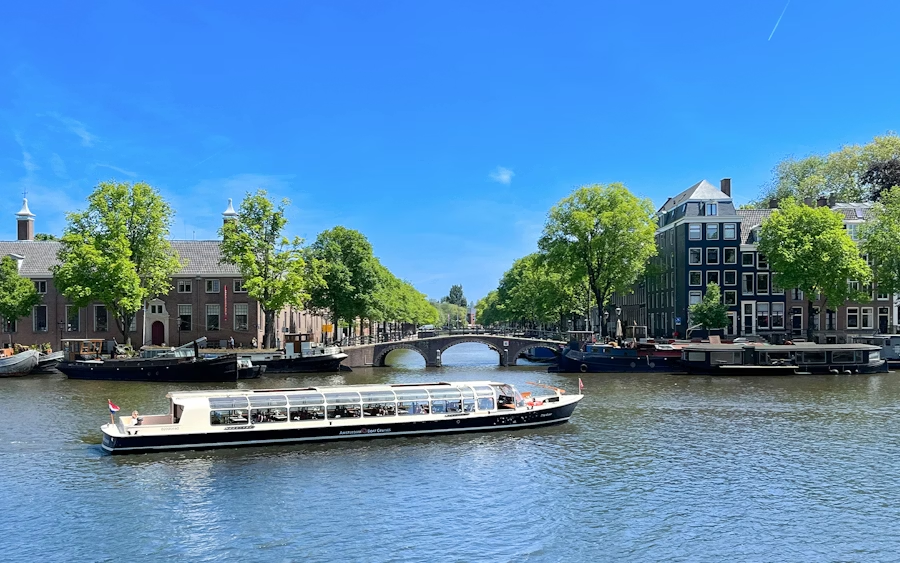
Amsterdam is one of those cities that gets under your skin. History doesn’t sit behind glass here, it’s alive in the streets, the waterways, the buildings that lean gently towards each other across narrow canals. If you’re arriving by an Amsterdam cruise, you’re in luck. The city is compact, walkable, and layered with stories stretching back nearly a thousand years.
Origins and Early Development
It all started rather modestly. Amsterdam began as a small fishing settlement in the 12th century, built where the Amstel River met the sea. A dam was constructed to hold back the water, and that, quite literally, is where the name comes from. Amstel Dam. Simple enough.
From those muddy beginnings, the settlement grew steadily into something much more significant. Its position along northern Europe’s waterways made it a natural meeting point for merchants and traders, and by the late Middle Ages it had become a proper commercial hub. Wander through the historic centre today and you’ll still find echoes of that early period, narrow alleyways, steep gabled rooftops, buildings that seem almost too tall for their foundations. It’s charming in a slightly precarious way.
The Golden Age: Art, Trade, and Prosperity
The 17th century is when Amsterdam really hit its stride. The Dutch Golden Age transformed the city into one of the busiest and wealthiest ports in the world. Ships arrived from across Europe and beyond, and the money that flowed in reshaped the entire city. The canal houses from this period are extraordinary, ornate gables, grand proportions, warehouses built to hold the riches of a global trading empire.
Art flourished alongside commerce. Rembrandt and Vermeer were both working during this period, producing paintings that captured Dutch life with an intimacy that still feels startling today. Much of their work ended up in Amsterdam’s museums, which are conveniently close together and easy to reach whether you’ve just stepped off an Amsterdam cruise or you’re midway through a longer stay.
The Canals: Engineering Marvels and Historical Icons
You can’t talk about Amsterdam without talking about the canals. They’re not just pretty, they were built with real purpose. Constructed mostly during the 17th century, the canal network was designed to manage water, move goods, and defend the city. The result is the Grachtengordel, or canal belt, a series of concentric rings that wrap around the city centre like a watery embrace.
Walking along the canal edges is one of the simplest pleasures Amsterdam offers. The bridges, the locks, the historic houses reflected in the water, it adds up to something
genuinely special. Taking a short boat tour gives you an entirely different angle, looking up at the city from below street level in a way that makes the architecture feel even more dramatic.
18th and 19th Centuries: Expansion and Modernisation
After the Golden Age came quieter times. The 18th century brought economic pressures and competition from other European powers, and Amsterdam’s dominance began to wane. It remained an important port, but the extraordinary momentum of the previous century had slowed.
The 19th century brought industrialisation, and with it a new wave of building and expansion. Roads were widened, new neighbourhoods appeared, and public institutions, schools, theatres, civic buildings, started to define what a modern city might look like. Walking tours often pick up on these contrasts quite nicely, moving between the cramped medieval streets and the broader, more orderly avenues that came later. Two completely different ideas about how a city should work, sitting side by side.
20th Century Challenges and Revival
The 20th century was difficult. Both world wars left their mark, though it was the Second World War that caused the deepest wounds. Amsterdam’s Jewish community was devastated, and the city has never forgotten it. The Anne Frank House on the Prinsengracht is one of the most visited sites in the Netherlands, and rightly so. It’s not an easy visit, but it’s an important one.
What followed the war was a genuine renewal. Historic buildings were carefully restored, public transport was overhauled, and the city started to find its footing again. Amsterdam developed something of a reputation for balancing preservation with forward thinking, and that instinct has served it well in the decades since.
Modern Amsterdam: A Living History
Amsterdam today is busy, international, and thoroughly alive, yet it never feels like it’s turned its back on the past. The museums are world-class, the canals are intact, and entire neighbourhoods still look much as they did centuries ago. For visitors arriving by an Amsterdam cruise, the city’s size is genuinely helpful. You don’t need hours of travel to get from the waterfront to the Rijksmuseum or the Jordaan district.
The Jordaan is worth a mention on its own. Once a working-class area built to house labourers and craftsmen, it’s now full of independent galleries, small restaurants, and the kind of streets that make you want to slow down and look properly. The contrast with the grander canal houses nearby tells you a lot about how layered this city really is.
Tips for Experiencing Amsterdam’s History
- Walking Tours: Guided walks focused on specific periods, the Golden Age, wartime Amsterdam, the medieval city, are consistently good value.
- Museum Visits: The Rijksmuseum, Van Gogh Museum, and Amsterdam Museum all offer depth and context in their own distinct ways.
- Canal Exploration: A stroll along the canal belt or a short boat trip reframes the city’s architecture beautifully.
- Historic Neighbourhoods: The Jordaan and the Begijnhof courtyard are both worth exploring slowly, without a timetable.
- Cultural Immersion: Markets, churches, and civic buildings connect you to everyday life across different centuries.
Amsterdam rewards the curious. However long you’ve got, there’s always another layer to find.