Joint Ownership vs Sole Ownership: Which Creates More Complexity During Divorce?

Dividing property during a divorce is rarely straightforward. When a couple separates, the family home is often the largest asset either person owns, and how it’s owned can have a major impact on how easily it’s dealt with.
One of the first questions that arises is whether a property is held jointly or in one person’s sole name. This single factor can significantly influence how long a settlement takes, how much it costs, and how much room there is for disagreement. In areas such as Reading and Berkshire, where property values have risen considerably over recent decades, getting this question right matters more than ever.
This article compares joint ownership and sole ownership directly, looking at how each tends to play out in divorce proceedings, and which is more likely to create complexity.
Sole Ownership vs Joint Ownership: The Basics
Sole ownership means the property is registered in one person’s name. However, legal title does not always reflect the full picture. A non-owning spouse may have a beneficial interest, particularly if they contributed to the mortgage or made improvements to the property.
Joint ownership means both parties hold legal title, either as joint tenants or tenants in common. Joint tenants share the property equally on death, while tenants in common can hold unequal shares. Courts consider both the legal structure and the practical contributions of each party when determining how to divide the asset.
On the surface, joint ownership might seem like the simpler starting point, since both names are already on the title. Sole ownership, by contrast, often raises an additional question before division can even begin: does the non-owning spouse have a claim at all?
How Sole Ownership Can Add Complexity
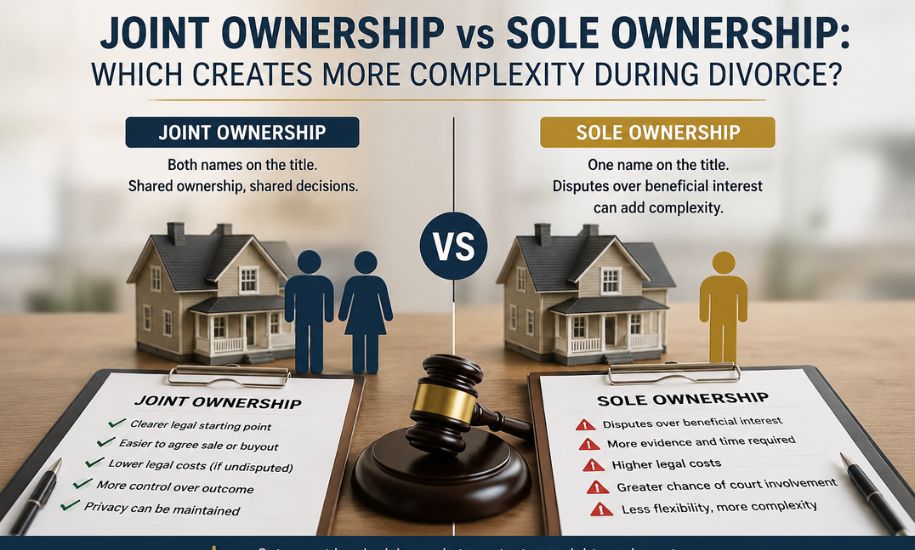
Sole ownership with a disputed interest tends to become drawn out when only one person is named on the title, but the other’s interest is disputed. Evidence of financial contributions, improvements, or informal agreements must be gathered before the court can even begin to assess division. Negotiations can stall if either party resists transparent disclosure.
The likelihood of court proceedings increases when disputes persist over true ownership or beneficial interest. Privacy exposure is also higher in these cases, since unresolved disputes are more likely to end up before a judge rather than being settled privately. Flexibility is reduced when ownership itself is contested, because the starting point for negotiation isn’t agreed.
Anyone in this position may want to speak to Stowe Family Law Reading early on, particularly where there’s a question over whether a non-owning spouse has built up a beneficial interest over time. Getting an early view on the strength of a potential claim can help shape realistic expectations before negotiations begin.
How Joint Ownership Can Still Get Complicated
Jointly owned family homes generally work best when both parties are willing to cooperate towards an agreed sale or buyout. Settlement tends to be easier where both parties provide accurate financial disclosure and agree on key details like valuation. Legal costs tend to remain lower compared with contested ownership, and privacy is maintained if a consent order is prepared.
That said, joint ownership doesn’t guarantee a smooth process. A common misconception is that joint ownership automatically means an equal split, but courts do not divide jointly owned property equally as a matter of course. The proportion each party is entitled to can still depend on contributions, needs, and the length of the marriage, which means joint ownership can still involve genuine disagreement, even if it starts from a simpler legal position than sole ownership with a disputed interest.
Comparing the Two: Which Creates More Difficulty?
Taken together, the comparison generally runs as follows. Jointly owned property with no dispute over the underlying entitlement tends to be the most straightforward, since both parties already have an acknowledged stake and the main questions relate to proportion and practicalities. Sole ownership with an undisputed beneficial interest sits in the middle, requiring evidence-gathering but not necessarily a fight over whether a claim exists at all.
Sole ownership with a disputed beneficial interest tends to be the most complex of the three, often involving the longest timelines, the highest legal costs, and the greatest likelihood of court involvement. Reading divorce lawyers often see this pattern play out repeatedly: cases involving disputed sole ownership simply take longer to resolve than those where joint ownership is already established and accepted by both sides.
Buy-to-let or mixed portfolios add a further layer regardless of ownership structure, since each property may need to be valued individually, and tax effects can be substantial. These cases often need specialist advice early on, and difficult assets require detailed financial disclosure and sometimes input from property or tax experts.
Core Decision Factors
Speed and Timing
Disputed property ownership, whether sole or joint, can extend proceedings significantly. When both parties accept the valuation and are willing to disclose finances openly, a negotiated settlement may conclude more quickly. A negotiated settlement tends to work best if both parties agree on value and entitlement, whereas court determination becomes necessary if ownership is genuinely contested and no agreement can be reached through structured negotiation.
Cost Direction
Valuation disputes, mortgage liability questions, and contested equity splits can all push costs upward, and this is particularly true where beneficial interest is disputed under sole ownership. Early financial disclosure may help reduce the overall cost of reaching an agreement. Many people consult Reading family solicitors specifically to get a realistic early view of likely costs before committing to a particular route.
Privacy and Confidentiality
Court proceedings create a public record, while mediated or solicitor-led settlements do not. For people with high-value properties or complicated ownership structures, protecting privacy can prevent details of their finances and asset structures from becoming public. Non-court routes allow both parties to keep negotiations, asset valuations, and financial agreements confidential.
Control Over Outcome
Agreed settlements allow both parties to shape the terms, whereas a judge’s determination may not reflect either party’s preferred outcome. A negotiated settlement is generally preferable for those who want to retain control over how the property is divided, while court involvement becomes the only option if agreement is impossible and a clear legal ruling is required.
Risk of Later Challenge
A consent order formalises any property agreement, regardless of whether the underlying ownership was joint or sole, and reduces the risk of future claims. Without one, informal agreements carry no legal weight, no matter how amicable the separation appeared at the time.
Get the Right Advice for Your Situation
Whether a property is held jointly or in one party’s sole name has a real impact on how a divorce settlement unfolds. Joint ownership tends to offer a clearer starting point, though it doesn’t guarantee agreement on proportions. Sole ownership, particularly where a beneficial interest is disputed, is more likely to involve extended timelines, higher costs, and a greater chance of court involvement.
Whatever the ownership structure, the same principles apply: get an independent valuation, account properly for mortgage liability, disclose finances openly, and formalise any agreement through a consent order. Taking advice early, before positions become entrenched, is often what makes the biggest difference to how smoothly things proceed.
If you’re facing a divorce involving property and want to understand where you stand, getting tailored advice as early as possible is the best next step. Speak to a specialist family law team to discuss your situation and the options available to you.
You may also read: Seth Cumming: Career, Family, and Biography Explained