Most venture capital firms are still running due diligence across a mess of shared drives, spreadsheets and email threads. One partner tracks documents in Google Drive, another logs calls in a spreadsheet, and the investment memo lives in a Word doc that nobody can actually find when it matters.
The information exists, but it’s all over the place. And that creates real risk when you’re trying to make a decision worth millions. So here’s how to pull the entire DD process into your CRM and stop things from slipping through the cracks.
Why Spreadsheets Break Down During DD
A spreadsheet can handle a checklist, sure. But it can’t link that checklist to a live deal record, flag overdue items automatically or give your partners a single view of where every active deal sits in the pipeline. Once you’re running due diligence on three or four companies at the same time, version control alone becomes a headache. Someone updates the wrong tab, someone else overwrites a note, and suddenly you’re second-guessing your own records in the middle of an IC meeting.
A CRM fixes this by tying every document, every stakeholder interaction and every decision log to one deal record. The data moves with the deal instead of sitting in a separate folder somewhere that half the team doesn’t even know about.
A Stage-Gated DD Template
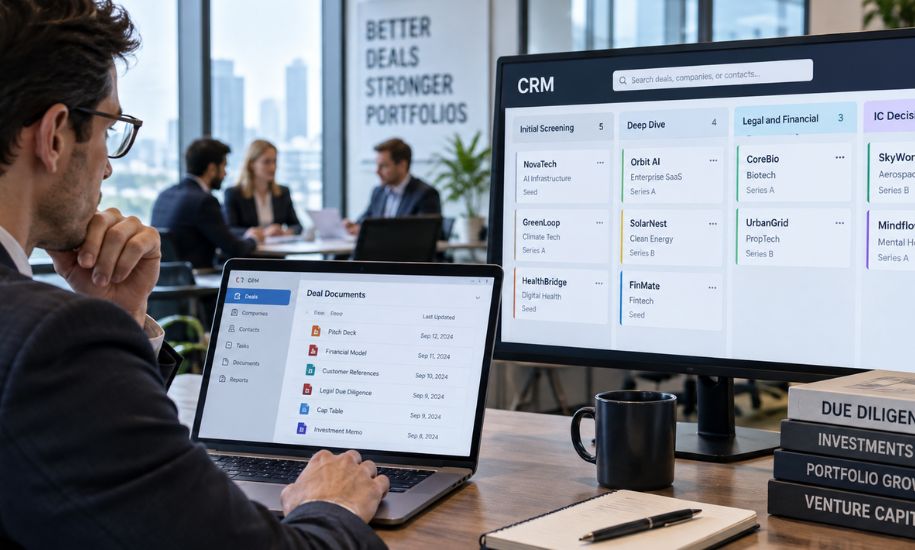
The simplest way to structure this is to mirror your actual due diligence stages inside your CRM pipeline. Most firms will use something like this:
- Initial screening – team sheet, pitch deck, basic financials collected
- Deep dive – customer references, technical review, market sizing complete
- Legal and financial – term sheet drafted, cap table verified, legal DD signed off
- IC decision – investment memo submitted, vote recorded, outcome logged
Each stage has a set of required fields or documents, and the deal can’t move forward until those are filled in. This is where a good CRM software for venture capital really earns its keep. Platforms with flexible data models will let you build these gates without needing a developer every time your process changes.
Stakeholder Tracking and Decision Logs
DD involves a lot of people. Founders, lawyers, co-investors, your own associates and partners. Your CRM should log every interaction against the deal record so anyone on the team can pick up the thread without having to ask around.
Decision logs matter just as much. When the IC votes, record the outcome, the key concerns raised and any conditions attached. Six months down the line, when you’re reviewing portfolio performance, you’ll want to know exactly why you said yes and what assumptions were on the table at the time.
A Cleaner Process Pays Off Later
Building DD into your CRM won’t just speed up your current deals. It’ll give you a searchable archive of every investment decision your firm has ever made, complete with the reasoning behind each one.
That’s the kind of institutional memory most firms wish they had but never actually get around to building. Start with one pipeline, one template and one deal, then refine from there.
You may also read: Finance.