The Bedtime Story Habit: How to Build a Calm Reading Routine With Your Child, From Toddler to Early Reader

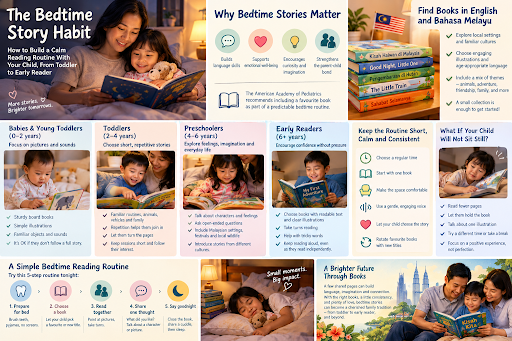
The end of the day can be one of the busiest times for parents. After dinner, bath time, tidying up, and preparing for tomorrow, getting a child to settle down for sleep can sometimes feel like another challenge. A simple bedtime story can make this part of the day feel calmer and more enjoyable.
Reading together does not need to involve a long chapter, an elaborate storytelling performance, or a perfectly quiet bedroom. A few minutes with a favourite book, a comfortable place to sit, and a parent’s familiar voice can become a meaningful daily ritual. Over time, children begin to associate stories with closeness, comfort, and the transition from an active day to a quieter evening.
For Malaysian families, bedtime reading can also be a lovely way to introduce children to both English and Bahasa Melayu. With suitable books, a little consistency, and room for children to make choices, parents can create a routine that grows alongside their child—from the first picture books to the exciting stage of reading independently.
Why Bedtime Stories Matter
A bedtime story is more than a pleasant way to end the day. Shared reading gives children opportunities to hear language, explore feelings, develop curiosity, and enjoy focused time with a trusted adult. The American Academy of Pediatrics recommends including a favourite book as part of a predictable bedtime routine. Even a short daily reading session can support language development and social-emotional skills.
Stories Can Help Children Wind Down
Young children often find it difficult to move directly from energetic play to sleep. A familiar sequence of activities, such as brushing teeth, changing into pyjamas, reading, and saying goodnight, can help them understand that bedtime is approaching.
A story provides a quieter activity that encourages children to slow down. The gentle rhythm of a parent’s voice and the familiarity of a favourite book may help make the transition to sleep more comfortable.
Reading is not a guaranteed solution for every bedtime difficulty, and children may still need reassurance or extra time to settle. However, keeping the routine predictable can make evenings feel less rushed and help children know what to expect.
Reading Builds Language Naturally
Every story introduces opportunities to hear words, sentence patterns, descriptions, and conversations. A picture of a busy market might prompt a parent to talk about fruit, colours, people, and sounds. A story about animals might introduce words such as gentle, curious, or enormous.
Parents do not need to turn reading into a formal lesson. Simply naming objects, responding to questions, and talking about illustrations helps children connect words with meaning.
For children growing up with English and Bahasa Melayu, stories in both languages provide valuable exposure to different vocabulary and expressions. Parents can read one book in English on some evenings and a Bahasa Melayu book on others, or discuss a story using whichever language feels most natural to the family.
Stories Strengthen the Parent-Child Bond
Bedtime reading creates a small space in the day when a child can enjoy a parent’s attention without the usual distractions. Sitting close together, laughing at a funny character, or talking about an interesting picture can help children feel heard and connected.
Books can also open conversations about everyday experiences. A story about starting school may help a child express nervousness, while a tale about friendship can encourage discussion about sharing and kindness.
The goal is not to ask lots of questions or teach a lesson every night. Sometimes, simply enjoying a story together is enough.
Choosing the Right Books for Each Age
Children’s reading interests change as their attention, language, and understanding develop. The best book is not necessarily the longest or most educational one. It is a book that suits your child’s current interests and makes reading together enjoyable.
Babies and Young Toddlers: Focus on Pictures and Sounds
For very young children, books are an opportunity to explore colours, shapes, faces, and sounds. Sturdy board books, simple illustrations, familiar objects, and rhythmic language are useful choices.
Parents can point to a picture and name it, imitate an animal sound, or repeat a short phrase. Babies may not follow a story from beginning to end, and that is perfectly fine. Looking at one page together can still be a worthwhile experience.
Choose books that are safe for your child’s age and stage, and supervise young children while they handle them.
Toddlers: Choose Short, Repetitive Stories
Toddlers often enjoy books that feature familiar routines, animals, vehicles, family members, and everyday adventures. Repetition is especially helpful because children can begin to anticipate what happens next.
A story with a repeated phrase gives a toddler the chance to join in by saying a word, making a sound, or pointing at a character. Letting your child turn the pages can also make reading feel like an activity they participate in rather than something they must sit still for.
Keep sessions short. If your toddler wants to look at one picture for several minutes, follow their interest instead of rushing through every page.
Preschoolers: Explore Feelings, Imagination, and Everyday Life
Preschool children can often follow a more developed story and enjoy discussing what characters do. Picture books about friendship, family, nature, school, and emotions can help them connect fictional situations with their own experiences.
You might ask, “What do you think the little rabbit is feeling?” or “What would you do if that happened?” If your child prefers to talk about the illustrations rather than answer questions about the plot, let the conversation develop naturally.
Stories involving Malaysian settings, familiar foods, festivals, family relationships, and local wildlife can make reading especially relatable. Books from different cultures can also introduce new experiences and perspectives.
Early Readers: Encourage Confidence Without Pressure
When children begin recognizing letters, sounding out words, and reading simple sentences, bedtime can become a chance to practise new skills. Choose books with readable text, clear illustrations, and a story that genuinely interests your child.
You can take turns reading pages, let your child read a familiar sentence, or read the main story aloud while they identify a few words. If they struggle with a word, offer help without turning the experience into a test.
Continue reading aloud even after your child can read independently. Listening to stories allows children to enjoy plots and vocabulary that may be more advanced than what they can comfortably read on their own.
Finding Books in English and Bahasa Melayu
A bilingual bedtime routine does not have to follow a strict formula. Some families may prefer alternating languages by night, while others may choose books based on the child’s mood or current interests. Both approaches can work.
When looking for story books for kids in Malaysia, parents can explore stories that reflect familiar surroundings as well as books that introduce children to new places and cultures. Look for engaging illustrations, age-appropriate language, and themes your child enjoys, whether that means animals, adventure, friendship, family life, or imagination.
Bahasa Melayu books can help children enjoy stories through the language they use with relatives, friends, and their wider community. English books can introduce additional vocabulary and sentence structures. A child does not need to understand every word to enjoy a story; parents can briefly explain unfamiliar terms when they naturally arise.
If you are unsure where to begin, children’s book recommendations for Malaysian parents can help you explore age-appropriate options in both languages and discover titles suited to your family’s interests. Consider recommendations from teachers, librarians, other parents, and children’s book specialists, but use your child’s response as an important guide.
A practical home collection might include:
- A few short Bahasa Melayu picture books.
- A few English stories with clear illustrations and accessible language.
- One or two favourite books your child requests repeatedly.
- A new title that introduces an unfamiliar topic or setting.
- Books that reflect your child’s current interests, such as dinosaurs, transport, animals, or school.
You do not need a large library to get started. A small collection that is easy to reach and enjoyable to revisit is often more useful than a shelf full of books your child rarely chooses.
Keep the Routine Short, Calm, and Consistent
One of the easiest ways to make bedtime reading last is to keep it realistic. If the routine is too long or complicated, it may become difficult to maintain on busy evenings.
Choose a Regular Time
Try to read at roughly the same point in your child’s bedtime routine. For example, you might brush teeth, put on pyjamas, choose a book, read together, and then say goodnight.
The exact schedule will depend on your household. What matters most is having a familiar sequence that your child can learn to recognize.
Start With Just One Book
You do not need to finish several stories every night. One short book—or even a few pages—can be enough to establish the habit.
On particularly busy evenings, tell your child in advance that there is time for one story. This helps set expectations while keeping the experience positive. If your child is tired, there is no need to stretch the session simply to meet a target.
Make the Reading Space Comfortable
Choose a quiet spot with comfortable seating and enough light to see the pages. Put televisions and other distracting screens aside during the story where possible.
Your reading space does not need special furniture or decorations. A bed, a cushion on the floor, or a chair beside your child’s bed can work just as well.
Use a Gentle, Engaging Voice
You can give characters different voices, pause for repeated phrases, or make an animal sound when it appears in the illustration. These small touches can help children stay interested.
However, you do not need to perform every story. Reading slowly and clearly is enough, and a quieter delivery may be more suitable when your child is already sleepy.
Let Your Child Choose the Story
Giving children some control can make them more enthusiastic about reading. Offer two or three suitable books and let your child choose which one to share. Older children can select a book from a small shelf or help decide which titles to borrow from a library.
Choice does not mean giving up the bedtime routine. Parents can still decide when reading begins and when it is time to sleep, while allowing children to choose between acceptable options.
If your child insists on the same story every night, there is usually no need to discourage the repetition. Familiar books help children anticipate words, notice details they missed before, and feel confident participating.
A repeated favourite can also be comforting. Rather than replacing it immediately, keep it available while occasionally introducing a new story alongside it.
Rotate Favourite Books With New Titles
A simple rotation keeps the reading collection interesting without overwhelming your child with too many choices. Keep a few current favourites within reach and put some other books away temporarily. After a week or two, swap a few titles.
You can introduce new books around topics your child already loves. A child who enjoys cats might be interested in a story about other animals; a child who loves buses might enjoy a book about travelling through a city. Familiar interests can make an unfamiliar story easier to approach.
Try rotating languages as well. If your child regularly asks for English stories, offer a Bahasa Melayu book about a similar subject, or vice versa. The aim is to create positive experiences with both languages, not to force a fixed balance every evening.
Libraries, book swaps, and borrowing from family members can also help families discover fresh titles without needing to purchase every book.
What If Your Child Will Not Sit Still?
Not every child wants to sit quietly and listen. Toddlers may turn pages quickly, wander away, point at unrelated objects, or ask to skip to a favourite illustration. Older children may be too excited about the day to settle immediately.
Try adapting the session to your child’s needs. Read fewer pages, let your child hold the book, or talk about one illustration instead of completing the whole story. You can also tell a short story from memory if a printed book is not available.
If your child repeatedly resists bedtime reading, avoid making it a battle. Offer a choice, try a different time within the bedtime routine, or take a break and return to the habit later. The long-term goal is to build a positive relationship with books, not to achieve a perfect performance every night.
A Simple Bedtime Reading Routine to Try Tonight
Here is one easy example that can be adapted for your family:
- Prepare for bed: Brush teeth, change into pyjamas, and put away distracting screens.
- Choose a book: Let your child pick one familiar favourite or a new title.
- Read together: Spend a few calm minutes reading aloud, pointing at pictures, or taking turns.
- Share one thought: Ask what your child liked, or simply talk about a character or picture.
- Say goodnight: Close the book, give a cuddle if your child enjoys it, and move on to sleep.
Some nights will go smoothly, and others will be interrupted by tiredness, questions, or unexpected family demands. That is normal. A sustainable routine is one that fits real family life.
Final Thoughts
A bedtime story habit does not need to be complicated to make a difference. A few shared pages can offer children a calm transition toward sleep, introduce new words, encourage imagination, and create a moment of connection at the end of the day.
Choose books that match your child’s age and interests, make room for favourites, and introduce new titles gradually. For Malaysian families, including both English and Bahasa Melayu stories can help children enjoy a rich variety of language and experiences.
Above all, keep reading warm and flexible. The aim is not to finish a certain number of books or turn every evening into a lesson. It is to help your child associate stories with comfort, curiosity, and the pleasure of spending time together. With patience and consistency, tonight’s short story can become a cherished family tradition that grows with your child.