Halal, Kosher, and Vegan in One Kitchen: Colour-Coding fora Dietary Separation

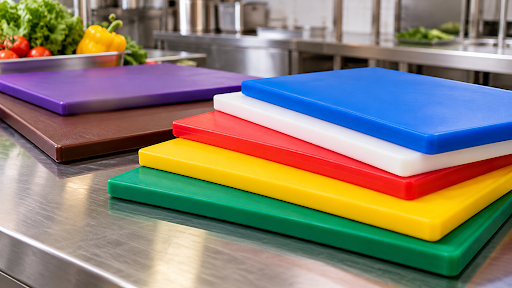
Running halal, kosher, and vegan orders from a single kitchen requires complete physical separation.
Standard commercial kitchens use chopping board colours to separate raw meats from cooked foods. However, that traditional hygiene scheme was not designed for religious rules or lifestyle diets.
When faith and ethics dictate your menu, you must adapt your tools. Implementing dedicated colour coded chopping boards is the most reliable way to prevent cross-contamination during busy shifts.
Why Standard Hygiene Systems Fail Special Diets
Traditional kitchen setups use six standard coloured chopping boards. This system sorts food purely by raw or cooked ingredients to stop bacterial contamination.
Standard Food Safety vs. Faith & Dietary Separation
| Standard Food Safety | Faith & Dietary Separation |
| • Prevents bacterial cross-contamination. • Focuses on raw vs. cooked. • Ignores origin of meat or dairy sources. | • Prevents religious or dietary cross-contact. • Focuses on ingredient purity. • Restricts specific animal origins, dairy mixing, and all allergens. |
A standard red board safely handles raw pork. However, it fails to specify if that surface is suitable for halal orders. Similarly, standard green boards handle raw vegetables. Yet, they are often stored alongside meat prep areas, which risks contamination.
To serve multi-faith and plant-based diners safely, you must assign food safety chopping board colours by dietary requirement rather than food state alone.
Mapping Board Colours to Specific Diets
Redefining chopping board colours removes guesswork for line cooks. By assigning one dedicated colour to every diet, your team maintains boundaries effortlessly.
| Board Colour | Dedicated Dietary Use | Key Rules |
| Green | Vegan and vegetarian prep only | Zero animal products allowed. |
| White | Dairy items | Keep away from meat. |
| Blue | Halal-certified meats | Never touch non-halal items. |
| Red | Non-halal meat and pork | Keep strictly isolated. |
| Purple | Free-from allergen orders | Mandatory for allergen safety. |
This clear breakdown allows any staff member to verify safety instantly. The entire system relies on strict consistency across every shift.
The Vegan Board: Green Done Properly
Plant-based diets require absolute purity. A single green chopping board kept exclusively for vegan prep protects that boundary.
Dedicated Green Board Rules:
- MUST NOT TOUCH: Meat, Poultry, Fish
- MUST NOT TOUCH: Dairy Products
- MUST NOT TOUCH: Eggs or Honey
Vegan preparation forbids all animal derivatives:
- No meat or poultry.
- No fish or dairy.
- No eggs or honey.
Storage is just as vital as prep execution. Keep your vegan boards isolated from meat prep stations. Wash them in separate cycles whenever possible.
High turnover demands reliable restaurant chopping boards that withstand constant cleaning without warping. A single mix-up on a shared surface destroys diner trust entirely.
Kosher and Halal: Advanced Equipment Separation
Religious dietary laws demand total discipline. A kosher kitchen operates on the absolute separation of meat and dairy.
To support kosher prep, assign a dedicated white chopping board solely to dairy foods. Pair it with a distinct colour for meat items, and never let them cross paths.
Kosher vs. Halal Preparation Requirements
- Kosher Separation:
- Keep dairy and meat separate.
- Use white boards for dairy.
- Use distinct meat boards.
- Halal Separation:
- Isolate permitted halal meats.
- Use blue boards for halal prep.
- Strictly exclude all pork.
Halal prep focuses on permitted sources and processing:
- Isolate certified halal meats.
- Exclude all pork products.
- Eliminate cross-contact with alcohol.
Dedicated colours keep these boundaries visible. Assigning specific prep zones guarantees that faith-based rules are respected consistently.
Managing Free-From Orders with Purple Boards
Allergen management runs parallel to dietary rules. A dedicated purple chopping board handles free-from meals safely.
Purple Board Purpose:
↓
_____________________________
↓ ↓
Protects diner health Ensures legal safety
Using purple for allergens is standard practice across modern kitchens. It protects diners who suffer from severe food allergies.
In a complex multi-diet kitchen, this dedicated colour prevents tragic errors. Allergy mistakes carry heavy legal liabilities, making purple boards completely non-negotiable.
Operational Guidelines for the Floor
A board system only works if your team respects it daily. Keep your rules straightforward so new cooks master them quickly.
Daily Kitchen Workflow:
Step 1: Onboard Staff → Step 2: Zone Storage → Step 3: Monitor Wear → Step 4: Custom Sizing
Follow these operational standards:
- Train new hires immediately. Walk every cook through your colour scheme on day one.
- Store boards in separate zones. Never stack different coloured boards directly together.
- Inspect board wear daily. Replace deeply scored boards that trap food particles.
- Invest in custom gear. Order bespoke chopping boards sized specifically for your line stations.
Custom-cut boards streamline workflow while keeping separation second nature for your crew.
FAQs
Can one kitchen safely prepare halal, kosher, and vegan food?
Yes, you can run all 3 safely. You must enforce strict physical separation for tools, prep spaces, and storage areas.
What colour board should I use for vegan food?
Use a green board exclusively for plant-based items. Keep it far away from meat, fish, and dairy stations.
Is purple only for allergens, or can it cover special diets too?
Purple is reserved exclusively for allergen-free orders. Assign different colours for religious or lifestyle diets to keep rules clear.
How many board colours does a mixed-diet kitchen actually need?
Most venues require five to seven colours. Audit your menu first, then order the exact board set your prep demands.