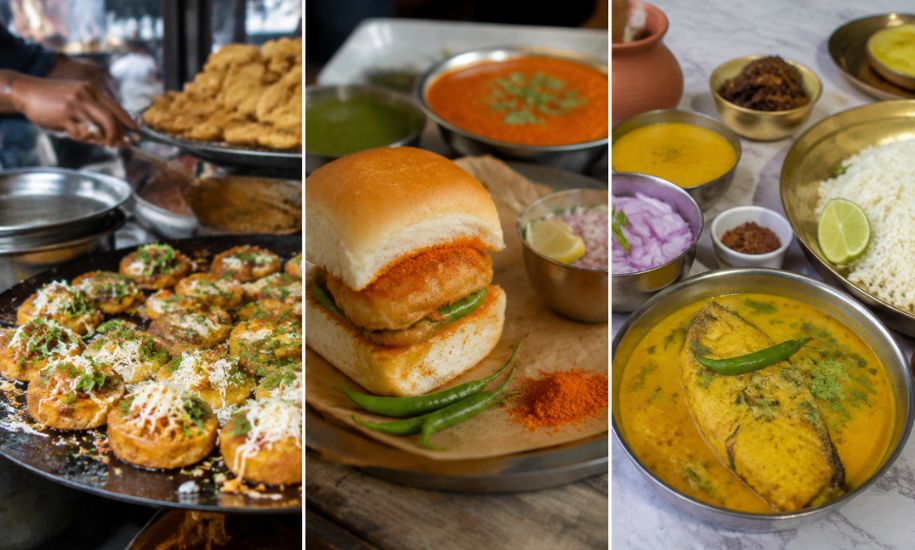
India is too large and varied to understand through one food city.
Every region has its own ingredients, habits, street snacks, sweets and mealtime rhythms. Even within one city, the food changes from old neighbourhoods to newer districts, from family kitchens to roadside stalls, from busy markets to late-night cafés.
For a first food-focused trip, Delhi, Mumbai and Kolkata make a strong route.
They are three very different cities, each with a clear food personality. Delhi is rich, spicy, layered and deeply tied to street food and North Indian cooking. Mumbai is fast, coastal, varied and shaped by people who have arrived from across the country. Kolkata is slower, sweeter, fish-loving and full of old cafés, Bengali kitchens and snack stalls.
Together, they give travellers a useful taste of India without pretending to cover everything.
Start in Delhi for chaat, kebabs and old-city eating
Delhi is a good place to begin because the food feels big from the start.
Old Delhi is where many visitors first understand the city’s appetite. The lanes are crowded, noisy and full of smells coming from grills, frying pans, sweet shops and spice stalls. This is not quiet eating. It is busy, close and full of movement.
Chaat is one of Delhi’s great strengths.
A plate of papdi chaat, aloo tikki, dahi bhalla or golgappa gives you crunch, heat, sweetness, yoghurt, chutney and spice in one place. The balance is the whole point. Too much of one thing and the dish falls flat. Done well, it wakes everything up.
Delhi is also known for kebabs, butter chicken, parathas, chole bhature and rich Mughlai-style dishes. Some meals feel heavy, but they suit the city’s colder months and old food traditions.
If you only eat in restaurants, you will miss a lot. Delhi’s food story is often on the street, in markets and around small places that people have trusted for years.
Give Delhi breakfasts their own time
Breakfast in Delhi can be serious.
Chole bhature is one of the best-known options. It is filling, oily, spicy and not designed for a light start. Hot bhature with chickpeas, pickles and onion can feel like a full meal before the day has properly begun.
Stuffed parathas are another classic.
Aloo, paneer, gobi or mixed parathas with butter, curd and pickle can be simple or heavy depending on where you eat them. In the right place, they are crisp at the edges, soft inside and full of flavour.
Then there is chai.
Tea is not just a drink you grab quickly. It is part of how the city pauses. A small glass of strong, sweet chai can sit between errands, conversations, train journeys and food stops.
Delhi can be overwhelming, but breakfast gives the city a more grounded start.
Mumbai is built for eating on the move
Mumbai feels different almost immediately.
The city moves quickly, and its food often matches that pace. People eat standing up, between trains, outside offices, near beaches, in markets and late at night after long workdays.
Vada pav is the obvious place to start.
It is simple: a spiced potato fritter inside a soft bread roll, usually served with chutney and fried green chilli. But the best versions are more than a snack. They are part of the city’s identity. Cheap, quick, filling and easy to eat while moving.
Pav bhaji is another Mumbai favourite.
It is buttery, spicy mashed vegetables served with soft bread rolls, and it works especially well in the evening. The smell alone can pull you towards a stall.
Bhel puri, sev puri, frankies, misal pav and Bombay sandwiches all show how Mumbai eats: fast, layered, practical and full of contrast.
Seafood gives Mumbai another side
Mumbai is not only street snacks and office lunches.
The city’s coastal side brings fish, prawns, crab and regional seafood cooking into the picture. Koli, Malvani, Goan, Mangalorean and other coastal influences all appear across the city in different ways.
A good fish thali can be one of the best meals in Mumbai.
You might get fried fish, curry, rice, sol kadhi, pickle and vegetables on one plate. The flavours are sharper and more coastal than the heavier food of Delhi. Coconut, kokum, chilli and fresh fish all play their part.
This is where a food route across India starts to make sense. Travellers often look at routes, rail journeys, hotel locations and flights to India as separate planning tasks, but the food itself can shape the trip just as strongly.
Delhi gives you spice and weight. Mumbai adds speed, seafood and street energy. By the time you reach Kolkata, the mood changes again.
Kolkata moves at a different pace
Kolkata’s food has a softer rhythm.
The city has famous street food, but it also has a strong culture of slow meals, old cafés, sweets, fish markets and family-style Bengali cooking. Food here often feels tied to memory, literature, festivals and long conversations.
Kathi rolls are a good starting point.
A paratha wrapped around egg, meat, paneer or vegetables, with onion, chilli and sauces, makes one of Kolkata’s most recognisable street foods. It is filling, easy to eat and strongly linked to the city.
Then there is puchka.
It may look similar to golgappa or pani puri, but Kolkata’s version has its own character. The filling is usually sharp, spicy and tangy, with tamarind water that gives it a different edge.
Kolkata also does cutlets, chops, mughlai paratha and roadside snacks extremely well. The food is not always polished, but it has personality.
Bengali food is built around fish, rice and balance
A proper Bengali meal deserves time.
Fish and rice sit at the heart of many meals. Mustard, poppy seeds, green chilli, yoghurt, coconut and simple vegetable preparations all appear in different ways. The cooking can be subtle, sharp, earthy or rich depending on the dish.
Mustard fish is one of the most famous examples.
The flavour can be strong if you are not used to it, but it is central to Bengali cooking. Hilsa, when in season, is especially prized, though it can be bony and is best eaten slowly.
There is also shukto, dal, begun bhaja, kosha mangsho, luchi, cholar dal and a long list of vegetable dishes that show how carefully Bengali meals are put together.
The food is not only about heat. It is about order, texture and balance.
Kolkata’s sweets deserve their own stop
Kolkata is one of India’s great sweet cities.
Rasgulla, sandesh, mishti doi, cham cham and other milk-based sweets are central to the city’s food identity. Sweet shops are not just places for dessert. They are part of daily life, family visits and celebrations.
Mishti doi is a good example.
This sweetened yoghurt is simple but deeply satisfying when done well. It is creamy, slightly caramel-like and usually served chilled in small clay cups.
Sandesh is lighter and more delicate than many visitors expect. It can be plain, flavoured, shaped or decorated, but the best versions rely on freshness rather than excess sugar.
After Delhi’s spice and Mumbai’s speed, Kolkata’s sweets make the route feel complete.
How to plan the route without rushing it
Delhi, Mumbai and Kolkata are major cities, so this route is easy to build around flights or trains.
A practical food trip could spend three nights in each city. That gives you time for street food, one or two slower meals, markets, cafés and a little sightseeing without making every day feel like a checklist.
In Delhi, stay somewhere with good access to Old Delhi, central markets and metro routes. In Mumbai, choose a base that works for both street food and coastal areas. In Kolkata, stay somewhere that lets you reach old food spots, sweet shops and central neighbourhoods without too much travel time.
Do not try to eat everything.
Pick a few dishes you really want, leave space for local recommendations, and avoid scheduling too many heavy meals in one day. Indian city food can be rich, and the best experiences often happen when you are not forcing the next stop.
A few simple food travel tips
Busy places are usually a good sign, especially for street food.
Food that is cooked fresh in front of you is often a safer choice than something that has been sitting around. Bottled water is sensible for visitors. If you are unsure about spice, ask before ordering, though “mild” can mean different things depending on the place.
It is also worth carrying cash for smaller stalls.
Many places take digital payments, but not every traveller will have access to local payment apps. Small notes can make things easier.
Most importantly, pace yourself.
The food in Delhi, Mumbai and Kolkata is exciting, but it can also be heavy. A good route is not about eating non-stop. It is about understanding how each city uses food to show its character.
Three cities, three different food moods
Delhi, Mumbai and Kolkata are not the whole of Indian food. No route could be.
But they make a strong starting point because each city gives something different. Delhi brings old-city eating, chaat, kebabs and rich North Indian dishes. Mumbai brings movement, seafood, snacks and street-side speed. Kolkata brings fish, sweets, rolls and a slower Bengali food culture.
Together, they show why food is one of the best ways to travel through India.
You learn through markets, breakfast stalls, late-night snacks, sweet shops and conversations over chai. You notice how people eat, when they eat, and what they return to again and again.
That is what makes a food trip memorable.
Not just the dishes, but the cities around them.
You may also read: Food & Drinks.