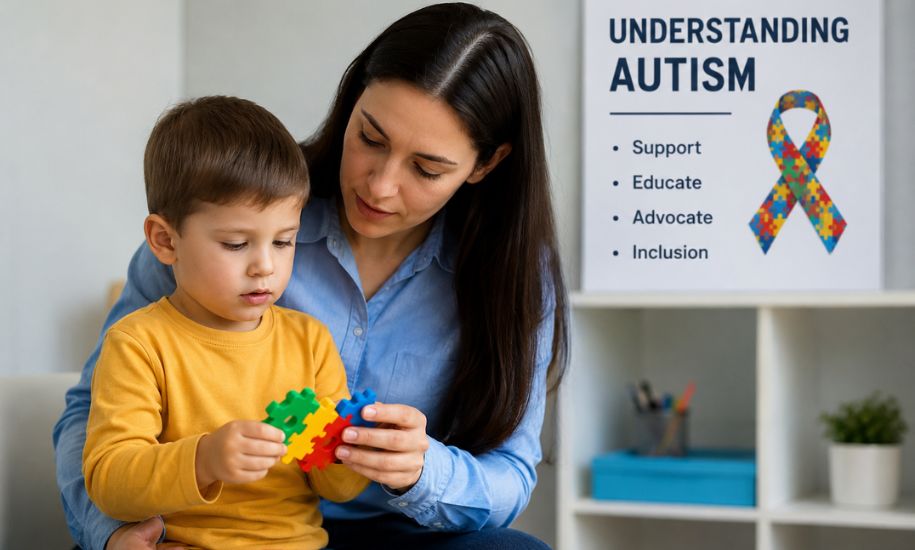
No medical treatment exists to remove Autism Spectrum Disorder (ASD) from an individual’s neurology. However, many ‘treatments’ claiming to ‘cure’ autism are marketed within the media. Some of these ‘treatments’ are described as ‘complementary and alternative’ (CAM) interventions for autism ‘recovery’ which are being bought off the shelves of health food stores and over the Internet by parents of children with autism as well as some clinicians.
The Neurological Foundation of Autism
While the cause or causes of Autism Spectrum Disorder (ASD) are not yet known, it is agreed by most in the medical field to be a neurological disorder affecting development and/or function of the brain. It is known that some individuals with autism have genetic differences; however, it is not known how these differences cause autism. There is strong evidence that Autism Spectrum Disorder is a multifactorial condition, which means that the causes are complex and can include both genetic and environmental factors.
Autism is a complex condition that is brought about by many genes. Each gene contributes a small amount of effect, and so far hundreds of genes have been identified to confer susceptibility to the condition. Studies of autism in identical twins have found that concordance rates for autism are around 80-90%, which suggests that the condition has a high heritability. It is likely that many different prenatal environmental factors also play a role in the development of the condition in children.
All attempts to alter the differences found in individuals with autism through medication and other medical interventions have failed.
The differences found in the brains of individuals with Autism Spectrum Disorders are variations of typical brain organization and therefore are not errors that need to be ‘cured’ or ‘fixed’.
Evidence-based Interventions That Actually Work
A wide variety of interventions have been put forth to support children and adults with autism spectrum disorder. Skills training, such as verbal behavior, teaching daily living skills, and other adaptive behaviors, as well as environmental modifications to support an individual with autism spectrum disorder, and medical treatment of co-occurring medical conditions of individuals with autism spectrum disorder are examples of interventions used to support individuals with autism spectrum disorder. The strongest body of evidence supporting an intervention for children with autism spectrum disorder is for the use of Applied Behavior Analysis (ABA) to improve communication, social, and adaptive behaviors in children with autism spectrum disorder. However, the quality of ABA intervention is highly dependent on the quality of the implementation and the behavior analyst providing the intervention.
There are many treatments, which are supported by strong evidence, to help individuals with autism Spectrum Disorder. These interventions focus on developing skills and adapting environments to support individuals with autism Spectrum Disorder. The behavioral intervention, Applied Behavior Analysis (ABA), has the most research evidence supporting its use for children with autism Spectrum Disorder. ABA can improve communication, social interaction, and adaptive skills in children with autism Spectrum Disorder. Early intervention, with intensive high quality ABA, is critical for optimal outcomes. Other interventions for which there is some evidence supporting their use are speech and language therapy and occupational therapy. Some individuals with autism Spectrum Disorder develop spoken language, while others use alternative and augmentative methods of communication, such as picture exchange or other forms of assistive technology. Some individuals also require assistance with daily living skills.
There are several other treatments intended to support individuals with autism as they acquire skills that will allow them to complete the activities of daily living. Other treatments are designed to help individuals with autism cope with the high levels of sensory sensitivity that are a part of the autism phenotype. Occupational therapy is perhaps the most well known of these interventions and there is somewhat less evidence to support the use of this type of treatment as compared to behaviorally focused interventions for young children with autism. However, there is some evidence that there are positive effects of using these interventions, especially for children who are older or have more severe autism.
The Marketing of False Hope
Many unproven treatments for the so-called “cure” of autism are being marketed to desperate parents of children with autism and are generating huge profits for the marketing companies behind these treatments.
There are many unproven methods of treatment that claim to search for an “autism cure”. Chelation therapy, hyperbaric oxygen treatment, and special diets (such as gluten-free/casein-free, and others) and supplements are but a few examples. Most of these methods have no scientific basis for their claims made regarding their effect on individuals with autism, and many have serious side effects. Some have even been reported to cause death. Testimonials and “before and after” photos and videos are not scientific evidence of anything.
As a result of the hope that parents have that they can help their child who has been diagnosed with autism, and their fear that their child will be locked away in an institution and never be able to live an independent life, there is a lot of money to be made marketing unproven autism ‘cures’. This can be very convincing with false testimonials, before and after photos, and heart-wrenching stories. Most of these stories are purely anecdotal and can be swayed by many factors.
Another reason why there are so many Autism “Cures” on the market by the supplement industry is that there is little to no regulation within the industry. There are many extremely expensive programs for which parents pay hundreds to thousands of dollars a year, without any guarantee of results.
Medical Treatment for Co-occurring Conditions
While there is no cure for autism, there are many individuals with autism who have treatable medical conditions, such as 40% of individuals with autism who have some level of anxiety. Typically individuals with autism develop anxiety in their teenage years and early adult years. Individuals with autism and anxiety can receive effective treatment for their anxiety using a combination of behaviorally based interventions and medication, under the guidance of a qualified physician.
In addition to seeking support for autism, individuals with autism often have other medical conditions which can be treated. For example, anxiety is estimated to affect about 40% of individuals with autism, but can be treated with a combination of behavioral techniques and/or medication, when appropriate. Additionally, sleep disorders, gastrointestinal difficulties, and epilepsy affect many individuals with autism, and are often associated with increased severity of autism symptoms. Treating these medical conditions can result in significant improvement in the individual’s overall quality of life. For example, children with autism who have improved sleep often show improved attention, and decreased problem behaviors.
Better sleep in kids enables them to pay better attention, to behave better, to have fewer behavioral problems.
Reframing Success
Autism cannot be ‘cured’ therefore the greatest achievements with people on the autism spectrum are when they reach their full potential and continue to grow and develop with appropriate support.
The most important advance in the support and inclusion of people with autism will be our increasing understanding of each individual’s natural strengths and needs, and how best to support that person to communicate; to be involved in the activities of their choosing; and to be part of the community of their choice in the way that is most natural and most preferred for them.
The greatest progress for individuals with autism is made when we support them to understand and make best use of their strengths and talents. A number of children and adults with autism have developed effective ways of communication and socializing, and with support, have learned to use a variety of methods and tools to do so. Others have talents for arts, technology, music and for problem solving. When individuals with autism are given the opportunity to use their talents, and to learn in learning in ways that are best suited to their learning style, they are able to reach their full potential and participate in their communities in meaningful ways.
The future of autism will be a world where people are fully supported to develop to their full potential in order to reach their goals and live fulfilling lives in the way that is most appropriate to them.
You may also visit: Health & Fitness.